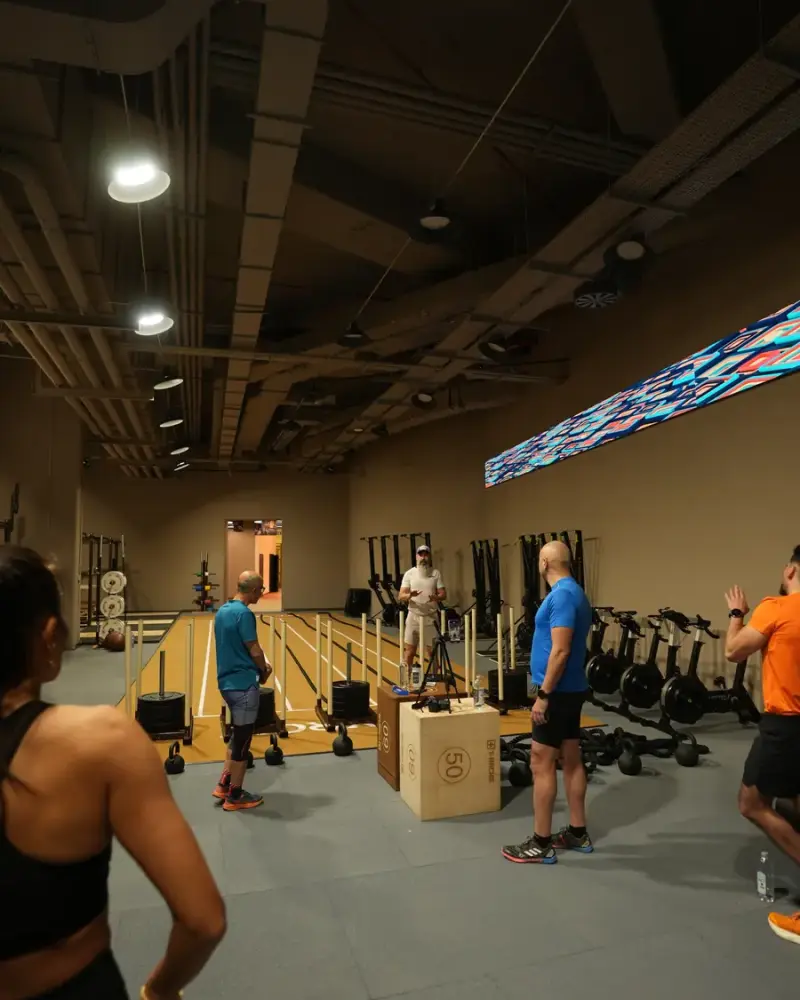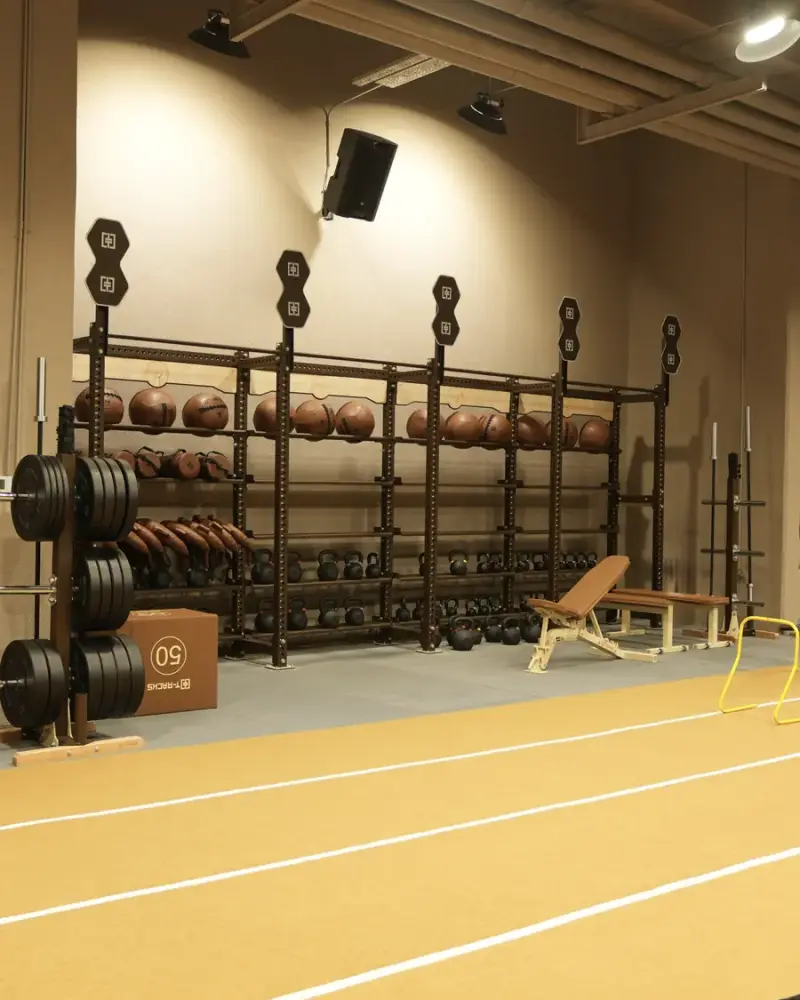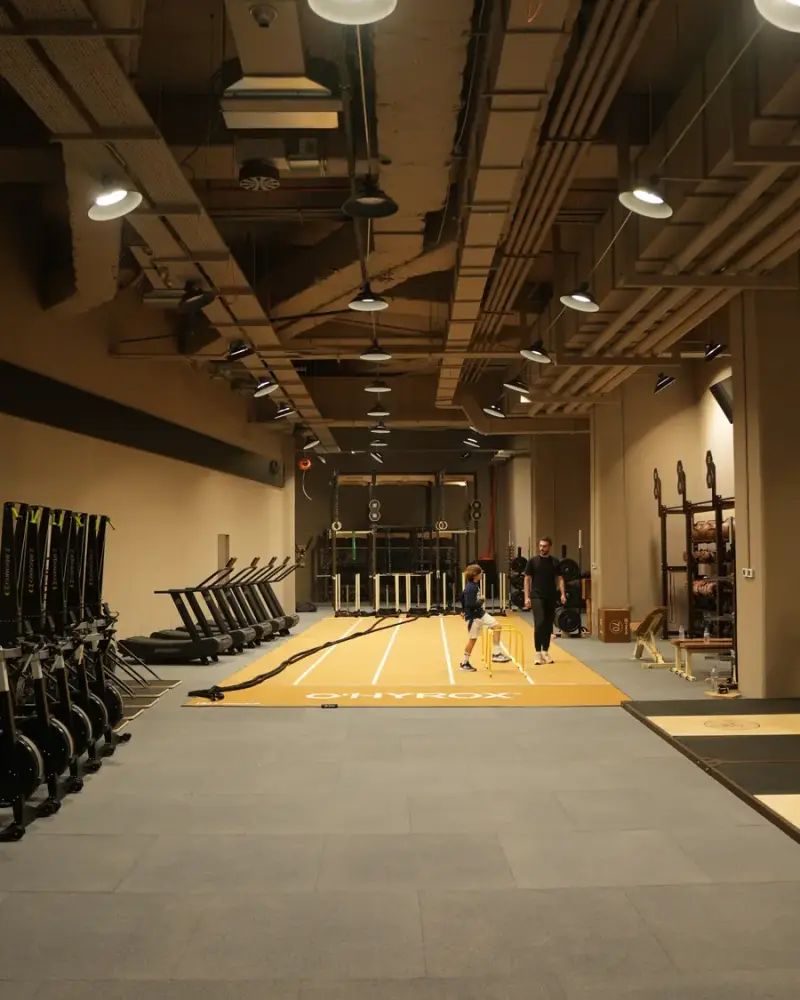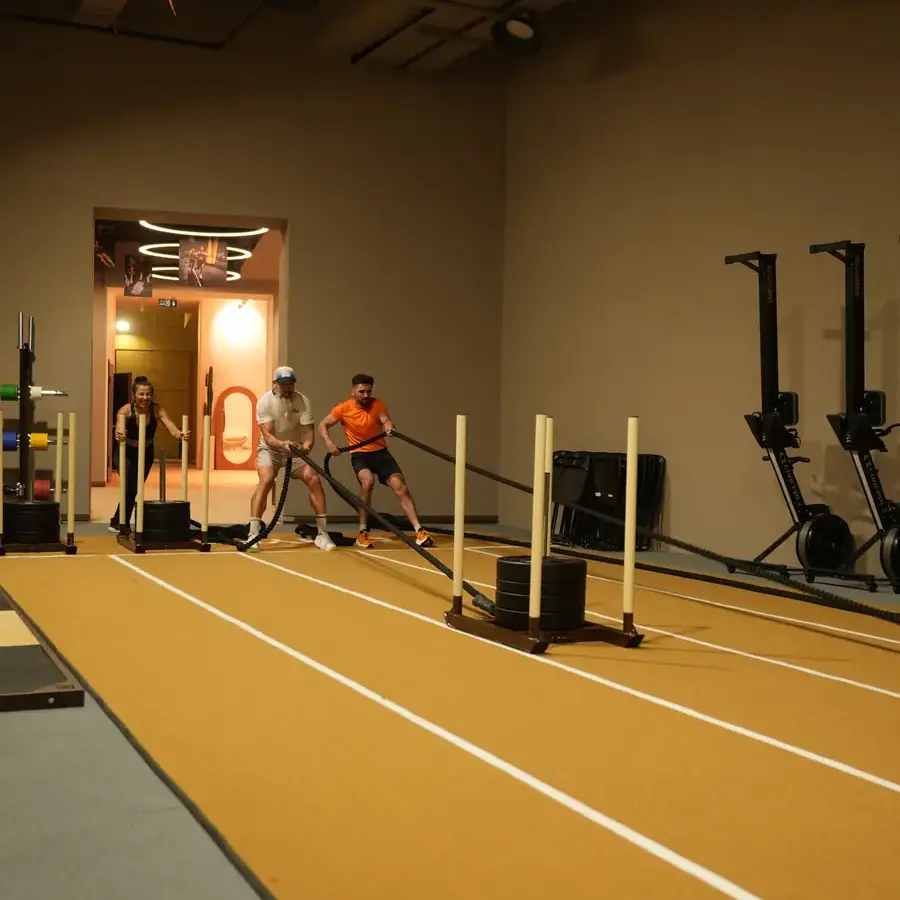
HYROX is an indoor race format, held to a single standard worldwide, in which a 1-kilometer run and a functional fitness station are repeated eight times. There are 8 kilometers of running and 8 stations in total; time is measured with a clock, and most athletes finish the race in 60 to 120 minutes. It's neither an obstacle course nor a variable CrossFit competition: the same distances, loads and order are used in every city, which is why the time you run in Istanbul can be compared directly with someone racing in Berlin.
The structure of a HYROX race: 8 runs, 8 stations, fixed order
The race always starts with a run. You complete 1 kilometer, enter the station area, finish that station's work and head back out onto the running course. This cycle repeats eight times. The order never changes, so you can map out the race fully in your mind beforehand.
| Order | Station | Work | Ability tested |
|---|---|---|---|
| 1 | SkiErg | 1000 m | Upper-body endurance, breathing rhythm |
| 2 | Sled Push | 50 m | Leg strength, torso angle |
| 3 | Sled Pull | 50 m | Back, hips, grip |
| 4 | Burpee Broad Jump | 80 m | Recovery capacity |
| 5 | Row | 1000 m | Leg-dominant power, pace control |
| 6 | Farmers Carry | 200 m | Grip, core stability |
| 7 | Sandbag Lunges | 100 m | Single-leg strength |
| 8 | Wall Balls | 100 reps | Leg endurance, mental toughness |
The transition area between stations is called the roxzone . The time you spend here is also added to your total time; thirty seconds lost at each of eight transitions adds up to more than four minutes in the end. Where experienced athletes pull furthest ahead of beginners is usually not the stations but these transitions.
How is HYROX different from other races?
HYROX's single most defining feature is standardization. In an obstacle course race, the weather, terrain and obstacles change at every event. In CrossFit competitions the movements differ from competition to competition, so results can't be compared. In HYROX, distance, load and order are fixed.
The practical upshot: you know exactly what you're preparing for. There are no surprise movements and no complex Olympic lifts to memorize. Preparation is built on the capacity to do eight specific tasks while fatigued. You can find a detailed breakdown of the format on our HYROX page ; for a technical comparison of the two disciplines, the differences between HYROX and CrossFit article.
Four categories: which one suits you?
- Open — Solo, with standard loads. Most first-time racers start here.
- Pro — Solo, with heavier loads and a higher wall ball target. For those looking for a place in the rankings.
- Doubles — Two people. You run every kilometer together and share the station work. The most accessible format for a first experience.
- Team Relay — Four people. Each athlete takes on two runs and two stations. Ideal for corporate teams and groups of friends.
For load differences between categories and selection criteria, the HYROX categories comparison is worth reviewing.
How fit do I need to be to take part in HYROX?
A common misconception is that HYROX is only open to advanced athletes. The truth is that finish times in the Open category spread across a very wide range, and most of the field is made up of ordinary people who train regularly. Breaking up wall balls, pushing the sled with a few breaks and mixing running with walking aren't grounds for disqualification.
A meaningful starting threshold is: being able to complete 5 kilometers without stopping and doing a basic squat with an empty bar pain-free. If you meet these two criteria, 12 weeks of structured preparation is enough for your first race. If you don't meet them yet, start by building the base rather than postponing the goal; the four-week starter plan is designed for exactly that.
What does training look like? The three-block logic
Good HYROX preparation means structuring three separate blocks within the same week. A program piled onto a single block collapses at its weakest link on race day.
1. The engine: aerobic capacity
Most of your weekly running volume is done at low intensity. The goal is to broaden your cardiovascular base and speed up recovery. Without this block, your heart rate won't come down between stations and the race falls apart in the second half. For details on the method, the Zone 2 training guide for more.
2. Station strength
Sled Push, Farmers Carry, Sandbag Lunges and Wall Balls require a certain strength threshold even when done on their own. Squats, deadlifts, single-leg work and grip training raise that threshold. When the strength block is neglected, the sled station turns into the most expensive five minutes of the race.
3. Simulation: working while fatigued
A wall ball done fresh and a wall ball done after 6 kilometers of running and 90 meters of sled aren't the same exercise. That's why one session a week deliberately chains running and stations back to back. This skill is called compromised running and it's the main factor separating beginners from experienced athletes in HYROX.
How do you set a target time?
In your first race, focusing on finishing rather than time is the healthiest approach. Still, a framework helps:
| Level | Approximate time | What it means |
|---|---|---|
| First race, completion-focused | 100-130 minutes | Some runs walked, stations broken up |
| Consistently training amateur | 85-100 minutes | Runs unbroken, controlled breaks at stations |
| Advanced amateur | 70-85 minutes | Pace control dialed in, efficient Roxzone |
| Competitive level | 60-70 minutes | No weak station, flawless pacing |
These ranges shift with gender, age and category; it's not a definitive table but a sense of direction. To measure your own starting point, you can follow the level test protocol.
The three most common beginner mistakes
- Running the first kilometer too fast. Getting swept up in the crowd and running 30-40 seconds faster than your normal pace costs you far more in the second half of the race.
- Never trying the sled. The Sled Push is a sensation with no equivalent in the gym. Trying it for the first time on race day costs minutes at that station.
- Not planning the wall balls. Those who don't go into the 100 reps with a breaking scheme from the start usually burn out around rep 30 and can't recover.
How 12 weeks of preparation is spread across the week
How the three blocks fit into the week matters more than the blocks themselves. Putting a high-intensity run the day right after a heavy strength session blunts the return on both stimuli. A typical week that works for an amateur who trains regularly looks like this:
| Day | Main work | Intensity |
|---|---|---|
| Monday | Station strength (squat-dominant) | High |
| Tuesday | Zone 2 run, 45-60 minutes | Low |
| Wednesday | Intervals: 4-6 × 800 m + station transition | High |
| Thursday | Mobility, ergometer, active recovery | Low |
| Friday | Station strength (pull- and carry-dominant) | Medium-high |
| Saturday | Half HYROX simulation (4 runs + 4 stations) | High |
| Sunday | Full rest or walking | None |
For someone who can set aside three days a week the logic doesn't change, it just compresses: one strength, one aerobic, one mixed session. How the weekly plan is structured in our program writing guide is explained step by step. The logic of cutting load in the last ten days is a separate topic; see the taper article.
What should you buy? The equipment you really need
HYROX isn't an expensive sport; the shopping list is short and most items are already in your closet.
- Shoes. This is the only real decision. Since half the race is running, a completely flat lifting shoe wears you out; on the other hand, an overly soft marathon shoe slips on the Sled Push. A training running shoe with moderate cushioning and a stable sole is the most balanced choice. For details, our shoe selection guide .
- Breathable apparel. Indoor temperature and humidity are high; a cotton T-shirt gets heavy when it's wet.
- Thin gloves or chalk. Useful for those whose grip slips on the Sled Pull and Farmers Carry; not mandatory.
- Heart rate strap. A chest strap is far more reliable than wrist measurement at high intensity and forms the basis of pacing work.
Knee sleeves, belts and compression socks are personal preference; they aren't items that determine performance.
Who is HYROX not suitable for?
To be honest, it isn't an ideal format for everyone. If you have an active knee, back or shoulder injury, the sled and lunge stations increase the risk; rehabilitation comes first, then preparation. For someone whose only goal is maximal strength or muscle mass, a HYROX program is also inefficient, because aerobic volume competes with the hypertrophy stimulus. In conditions like cardiovascular disease, uncontrolled hypertension or pregnancy, you need a physician's approval before starting the program.
For the large majority outside these cases, the most valuable thing about HYROX is that it's measurable: when you repeat the same test three months later, your progress isn't a guess but data in seconds. If you want a closer look at how we work, our concept page you can read, or go straight to you can message us.
Where to start?
The best-loved thing about HYROX is that the entry door is wider than people think. You don't even have to go to a race; the same program measurably changes the conditioning, strength and body composition of someone who trains regularly. At Hybrid Sky, every session starts with a level test, and the program is written to your level and goals. To see the weekly flow, the class schedule, to explore the session types, see the classes page take a look.
Do I need to be a competitive racer to take part in HYROX?
No. The Open category is open to anyone who trains regularly; mixing running with walking or breaking up stations isn't a rule violation.
How many minutes does HYROX take?
Most athletes finish in 60 to 120 minutes. For first-time racers, a range of 100-130 minutes is normal.
Are HYROX and CrossFit the same thing?
No. In CrossFit competitions the movements vary; in HYROX the distance, load and order are fixed worldwide, so results are comparable.
How long does it take to prepare for HYROX?
For someone with a regular training history, 12 weeks is enough. Someone without a base should first start with an 8-week general conditioning block.
A stronger version of you.
Just one step away.
24 hours from your first message to your first session. Let's build your program together — reach out on whichever channel suits you.
Weekdays 06:00 - 23:00