Compromised running is the ability to run right after strength or station work, with loaded legs and a high heart rate. In HYROX this isn't a side detail, it's the definition of the race: only the first of the eight kilometers is run on fresh legs, and the remaining seven start coming off a station. That's why an athlete who runs 5 km in 22 minutes can slow by up to a minute and a half per kilometer in the race. The good news: this loss can be narrowed significantly with training, and the method is simple.
Why is running on tired legs so different?
The difference between fresh and fatigued running isn't down to a single cause; it's three separate effects stacking up.
- Neuromuscular fatigue. After Wall Balls or Sled Push, the muscle has to recruit more motor units to produce the same force. Stride length shortens and ground contact time lengthens.
- Redistribution of blood flow. When you come off an upper-body-dominant station like the SkiErg, a large share of your blood is in your arms and shoulders. For the first 200-300 meters, your legs take a back seat for oxygen.
- Disrupted breathing rhythm. After Burpee Broad Jumps, breathing is shallow and fast. Settling it into a running rhythm requires deliberate intervention; letting it correct itself can take 400 meters.
Together, these three effects produce what we call the “first 200 meters wall” in HYROX. The most measurable skill separating experienced athletes from beginners is how quickly those first 200 meters return to normal.
Measure your loss: two simple tests
Before writing a program, you need to know your current loss. Two tests are enough, and both fit in a single session.
| Test | Protocol | What it measures | Good range |
|---|---|---|---|
| Fresh 1 km | A single 1 km after a warm-up, at submaximal race pace | Baseline running speed | Your own reference |
| Loaded 1 km | 1 km immediately after 50 wall balls | Resistance to leg fatigue | 8-15% slower than fresh time |
| 1 km after Ski | 1 km immediately after 1000 m SkiErg | Breathing and blood redistribution recovery | 5-10% slower |
| 400 m after sled | 400 m immediately after 50 m sled push | First 200 meters recovery | Within 10% of your 400 m pace |
Slowing by more than 20 percent shows that compromised running should be a priority in your program. If you're under 8 percent, your weak link is most likely elsewhere; to find where, use the station analysis in the find your weak link article.
Four training methods: from easiest to most specific
1. Brick sessions (strength + run back to back)
The simplest entry point. A 15-20 minute continuous run right after a strength session. The goal isn't speed; it's maintaining good form on loaded legs. Once a week, at the tail end of strength day.
2. Sandwich intervals
The run is sandwiched between two pieces of work. Example: 15 wall balls → 400 m run → 15 wall balls. This is the structure closest to the actual race sequence. 4-6 rounds, 60-90 seconds between rounds.
3. Loaded short repeats
200-meter runs, each preceded by a 20-second load (30 seconds of sled push, 10 burpee broad jumps, or 20 sandbag lunge steps). 10-12 reps. This format directly targets first-200-meters skill.
4. Full station-run chain
Doing part of the race sequence faithfully: 1 km run → 1000 m SkiErg → 1 km run → 50 m sled push → 1 km run. This is the most taxing session and shouldn't be done more often than every 2-3 weeks. For the logic of full and half rehearsals, see HYROX simulation article.
Eight-week compromised running block
The block below assumes one compromised running session a week plus one pure quality running session a week. Never drop the pure running session: the ceiling of your fatigued running speed is set by your fresh running speed.
| Week | Session | Volume | Target RPE |
|---|---|---|---|
| 1-2 | Brick: strength + 20 min continuous run | ~4 km | 5-6 |
| 3-4 | Sandwich: 5 rounds (15 wall balls + 400 m + 15 wall balls) | 2 km run + 150 wall balls | 7 |
| 5 | Loaded 200s: 12×200 m, 10 burpee broad jumps before each rep | 2.4 km | 8 |
| 6 | Chain: 1 km + SkiErg 1000 m + 1 km + sled push + 1 km | 3 km + 2 stations | 8 |
| 7 | Heavier sandwich: 6 rounds (20 wall balls + 400 m) | 2.4 km | 8-9 |
| 8 | Deload: brick, strength + 15 min easy run | ~3 km | 4-5 |
At the end of eight weeks, repeat the tests. For most athletes, the slowdown drops from the 15 percent range to the 8-10 percent range. To adapt the block structure to your own calendar, use the template in the weekly program design article.
First 200 meters technique: what to do and what not to do
Coming off a station, the first 200 meters set the pace for the whole run. Three concrete rules:
Set cadence before speed. Trying to lengthen your stride when your legs are tired is both slow and raises injury risk. Coming out, aim for short, quick steps at a cadence of roughly 175-185 steps per minute; speed will follow. For cadence work, see the cadence and efficient running we covered in the article.
Take control of your breathing. For the first 30 seconds, deliberately switch to an in-for-two-steps, out-for-three-steps rhythm. An athlete who waits for their breathing to settle on its own loses 400 meters.
Use your arms. Especially after the SkiErg and Farmers Carry, the shoulders drop and the arm swing stops. Deliberately restarting the arm swing calls the lower body's rhythm back.
And here's what not to do: sprint the first 50 meters off a station, hold your breath to suppress the feeling of fatigue, or lean your torso forward. All three gain you seconds in the first kilometer and cost you minutes over the next three.
Limited equipment: compromised running without a sled or SkiErg
Not every gym has a sled or a SkiErg. To produce the fatigue stimulus, you don't need exact copies of the race stations; what matters is fatiguing the right muscle group for a set time right before the run. Equivalent substitutions:
| Race station | Equipment-free / simple alternative | Time or reps |
|---|---|---|
| Sled Push 50 m | Hill walking, or fast walking on a treadmill at 12% incline | 45-60 seconds |
| Sled Pull 50 m | Heavy single-arm row or resistance band pull | 20-25 reps |
| SkiErg 1000 m | Resistance band lat pull-down, or 700 m on a rowing machine | 3-4 minutes |
| Wall Balls 100 | Air squats + arm raises to chest height | 50-60 reps |
| Sandbag Lunges 100 m | Walking lunges with a weighted backpack | 40-50 m |
| Farmers Carry 200 m | Carrying two water jugs or dumbbells | 100-150 m |
A sandwich session built with these alternatives delivers most of the effect of one built with race stations; what's missing is technical specificity. That's why, when you have access to equipment, you should train with the real stations at least once a month. We compiled fully equipment-free solutions in the HYROX training at home article; for travel periods, the keeping up training while traveling article is useful too.
Who should do how much compromised running?
These sessions are taxing and carry a high recovery cost. A practical framework for weekly distribution:
- 12+ weeks to race: 1 compromised session a week, light format (brick). Focus on aerobic base and strength.
- 8-12 weeks to race: 1 session a week, sandwich format. Plus 1 pure interval session a week.
- 4-8 weeks to race: 1-2 sessions a week; one sandwich, the other a chain every two weeks.
- 0-3 weeks to race: 1 short session a week, volume halved, intensity maintained. You'll find the taper rules in the taper article.
Putting two compromised sessions on consecutive days is the most common mistake. Leave at least 72 hours between them; zone 2 running and mobility in between are enough. The role of aerobic base work Zone 2 training article.
A common question: can't I just run more?
No, but the reverse isn't true either. An athlete with low weekly running volume can't progress with compromised sessions, because their baseline running speed is limited. The balance is: roughly 70-80 percent of weekly running volume should be pure running at easy and moderate intensity, and 20-30 percent should be done under fatigue. When this ratio breaks down, either the base doesn't develop or the specific skill isn't acquired. You'll find details on volume and intensity distribution in the volume and intensity balance article.
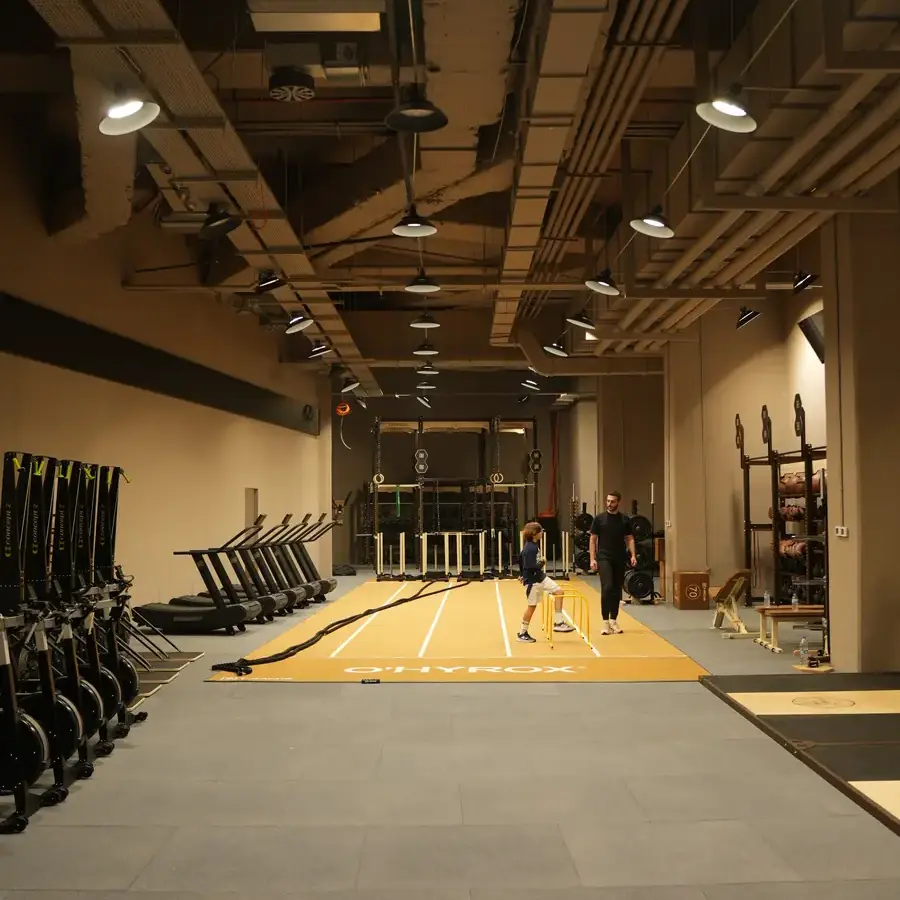
At Hybrid Sky, we combine station and running sessions under one roof; because the running track and station area sit side by side, transitions can be set up close to race conditions. The weekly flow in the class schedule, and the session types on the classes page for more.
How many times a week should I do compromised running?
If you're more than 8 weeks out from the race, once a week is enough; in the last 8 weeks, one or two sessions a week. Leave at least 72 hours between two sessions.
My fresh running speed is good, but I slow down a lot in the race. Why?
This is a typical specificity gap. Your aerobic base is sufficient, but you're not accustomed to neuromuscular fatigue coming off a station. Sandwich intervals are the format that closes this gap fastest.
Is it wrong to walk coming off a station?
It's not wrong, and it's not against the rules. But unplanned walking usually ends with your pace collapsing. If you're going to walk, set the duration in advance: walk for 20 seconds, then set your cadence and transition into running.
These sessions make my knee hurt. Should I keep going?
Feeling fatigued is normal, but joint pain that sharpens at a specific point or persists after the session is not. Pull back the volume, and if the complaint persists, see a doctor.
A stronger version of you.
Just one step away.
24 hours from your first message to your first session. Let's build your program together — reach out on whichever channel suits you.
Weekdays 06:00 - 23:00