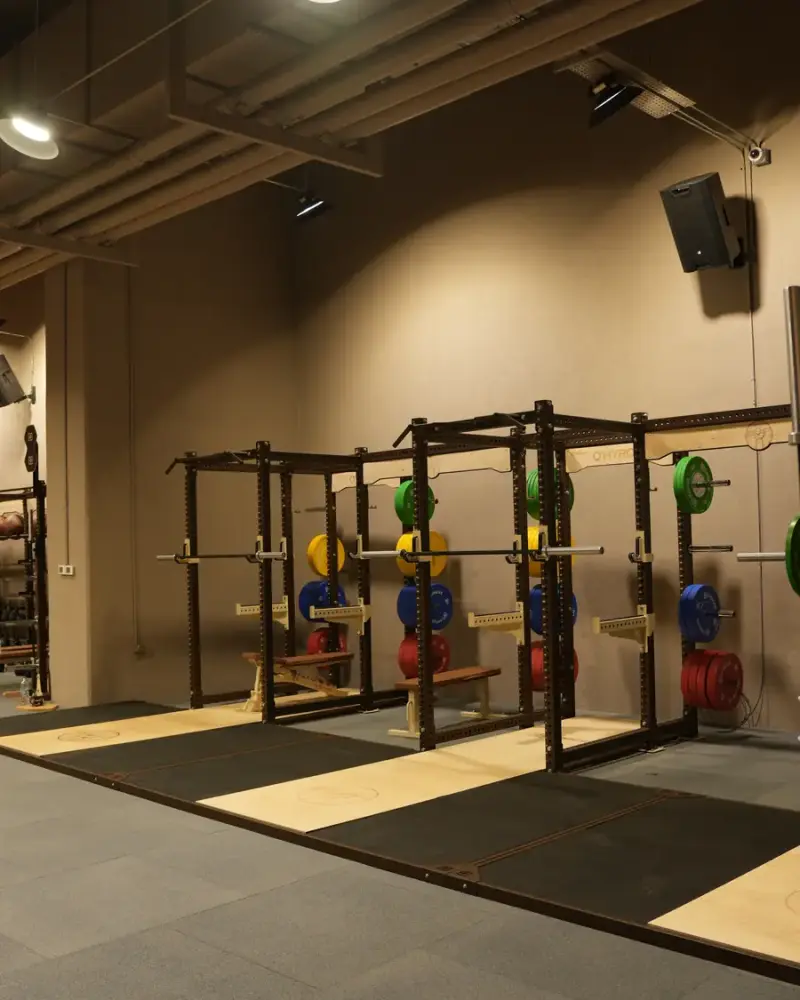
The logic of writing a weekly HYROX program is this: instead of stringing random sessions through the week, place four block types that won't undermine each other (running quality, aerobic base, strength, station-specific) on fixed days. A well-written week answers three questions: which days hold the two hardest sessions, how many hours are between them, and how much has the week's total load increased compared with last week. Below are 3, 4, 5, and 6-day templates and the rules for sequencing the blocks.
Four block types and their weekly roles
Every HYROX session falls into one of four categories. Mixing categories is the most common program mistake: a session with “a bit of running, a bit of strength, a bit of stations” doesn't load any of them enough.
| Block | Goal | Weekly share | Typical duration |
|---|---|---|---|
| Running quality | Speed, threshold, running economy | 1-2 sessions | 45-60 min |
| Aerobic base (Zone 2) | Recovery capacity, mitochondrial adaptation | 1-2 sessions | 40-75 min |
| Strength | Squat, hinge, carries, pulls | 2 sessions | 50-70 min |
| Station-specific / hybrid | Compromised running, station technique and endurance | 1-2 sessions | 45-70 min |
Total session count varies between 3 and 6. An athlete training three days has to combine two blocks in each session; an athlete training six days can separate the blocks and therefore gets more out of each. To decide how many days you need to set aside, how many days a week article.
Sequencing rule 1: put 48 hours between hard days
The two hardest sessions of the week are usually running quality and heavy strength. Putting them back to back lowers the quality of both. Practical rule: leave at least 48 hours between high-intensity running and heavy lower-body strength. Zone 2, mobility, or an upper-body-dominant session can go in between.
The only exception to this rule is a deliberately built two-day heavy block: for experienced athletes, loading Saturday and Sunday back to back and then taking two light days can work. But this approach requires recovery monitoring and isn't recommended for an athlete in their first season.
A second rule is not to have a heavy leg day before the weekend's long session. If Saturday is a simulation or long hybrid session, Friday is either rest or light upper body.
Sequencing rule 2: order within the same day
If you have to put two blocks on the same day, order determines the outcome. The rule: the ability you want to develop that day comes first.
- If running speed is the goal: Intervals first, then strength. The reverse order noticeably lowers average running pace.
- If maximal strength is the goal: Lifts first, then an easy run. Heavy squats on tired legs are both inefficient and risky.
- If compromised running is the goal: Deliberately do station work first, then run. Here fatigue isn't a mistake, it's the point.
- If both matter: Spread the sessions across the day, with at least 4-6 hours between them.
How strength and endurance affect each other on the same day interference effect we covered in detail in the article.
Sequencing rule 3: cap the weekly load increase
When a week goes well, doubling the volume is the easiest mistake to make. A safe increase framework: roughly 8-10 percent a week in total running distance, 1-2 sets a week in strength volume, and one extra high-intensity session every 3-4 weeks. A pattern of three weeks of increase and a fourth week of pulling back (deload) works well for most athletes. You'll find how a deload week is built in the deload week article.
Templates: 3, 4, 5, and 6-day weeks
3-day week (time-limited)
| Day | Session | Content |
|---|---|---|
| Monday | Strength + short run | Squat, hinge, carries + 15 min easy run |
| Wednesday | Running quality | 6×800 m or 20 min tempo |
| Saturday | Hybrid / stations | Sandwich intervals or half rehearsal |
4-day week (most common)
| Day | Session | Content |
|---|---|---|
| Monday | Strength A | Squat-dominant + Wall Ball volume |
| Tuesday | Running quality | 400-800 m intervals |
| Thursday | Strength B | Hinge-dominant + carries + sled |
| Saturday | Hybrid + Zone 2 | Station chain or 60-75 min easy run |
5-day week
| Day | Session | Content |
|---|---|---|
| Monday | Strength A | Squat-dominant, 4-5 sets |
| Tuesday | Running quality | Intervals, 4-6 km total quality volume |
| Wednesday | Zone 2 + mobility | 45-60 min easy run or row |
| Thursday | Strength B | Hinge, pulls, carries |
| Saturday | Hybrid / simulation | Half rehearsal or compromised session |
6-day week (advanced)
To the five-day template, a 60-90 minute low-intensity session (long easy run or swim) is added on Sunday. A sixth day only makes sense if sleep, nutrition, and stress management are in order; otherwise it leaves the door open to overload. Overtraining symptoms overtraining syndrome article.
Writing strength days: the A and B split
Instead of writing two strength sessions with the same content, splitting them by pattern both eases recovery and broadens coverage. A practical split:
- Strength A (squat-dominant): Main lift: back or front squat 4×5. Then Bulgarian split squat 3×10, Wall Balls 4×25, core block.
- Strength B (hinge-dominant): Main lift: deadlift or Romanian deadlift 4×5. Then heavy single-arm row 4×10, Farmers Carry 4×100 m, Sled Push 6×20 m.
Matching the accessory movements after the main lift to the HYROX stations ensures that strength day transfers directly to the race. Which lifts actually work Strength training for HYROX we covered in the article; for squat choices, squat variations article.
Linking the program to the calendar: what changes week by week?
The weekly template stays fixed; the content changes. The shift in emphasis based on time to race:
| Period | Emphasis | Strength character | Running character |
|---|---|---|---|
| 12-9 weeks out | Base and strength | Heavy, low reps | Zone 2-focused |
| 8-5 weeks out | Specificity | Moderate load, station volume increases | Threshold and intervals |
| 4-2 weeks out | Race pace | Volume drops, intensity maintained | Race pace repeats |
| Final 10 days | Taper | Very light, technical | Short and sharp |
The full calendar version of this transition in the 12-week preparation program, and a more compressed version in the 8-week accelerated plan . If you want to read up on periodization logic from the ground up, start with the periodization article.
How do you measure volume? Four practical units
“This week was hard” isn't enough to write a program. Four units are enough to put weekly load into numbers, and all of them can be calculated on your phone in two minutes.
- Total running kilometers. Including warm-up and cool-down. In HYROX preparation, 20-40 km a week is a reasonable range for most intermediate athletes.
- Quality running kilometers. Distance run at threshold intensity or above. Keeping it under 20-25 percent of the total usually gives a more sustainable trajectory.
- Weekly main lift set count. The total of sets of 5 reps or fewer on squats, deadlifts, and their variations. A range of 12-20 sets forms a practical band.
- Session × RPE total. Multiply each session's duration by that session's RPE and add up the week. This single number is the most useful measure for week-to-week comparison. How RPE is used RPE scale article.
Noting these four numbers every week takes the guesswork out of programming. For example, if the log of an athlete who can't get close to their time goal shows quality running at 40 percent, the problem isn't motivation, it's distribution. We systematized the logging routine in the training log article.
After writing the program: three check questions
Before putting the week you've written into practice, ask yourself these three questions. If you answer “no” to any of them, the week needs to be reorganized.
- Are there at least 48 hours between your two hardest sessions?
- Is every station pattern (squat, hinge, carry, pull, lunge, run) loaded at least once during the week?
- Did this week increase by more than 10 percent over last week?
At Hybrid Sky, programs are written with this block logic and adapted to the number of days an athlete can commit each week. To see the weekly flow, visit the class schedule, to explore the session types, see the classes page for more.
How many days a week should I do HYROX training?
Four days is the most productive balance for most athletes: two strength sessions, one quality run, one hybrid session. You can still progress on three days, but you'll need to combine blocks within sessions.
Do I have to put running and strength on the same day?
If time is tight, you may have to. In that case, do the quality you most want to develop that day first, and if possible leave a few hours between the two sessions.
How often should the program change?
The weekly skeleton can stay the same for 8-12 weeks. What changes is the content: loads, rep counts, and running paces are updated every 3-4 weeks.
I missed a session; should I make it up?
No, don't try to cram the week. Skip the missed session and continue in the planned order; stacking two hard sessions back to back costs more than the missed session.
A stronger version of you.
Just one step away.
24 hours from your first message to your first session. Let's build your program together — reach out on whichever channel suits you.
Weekdays 06:00 - 23:00