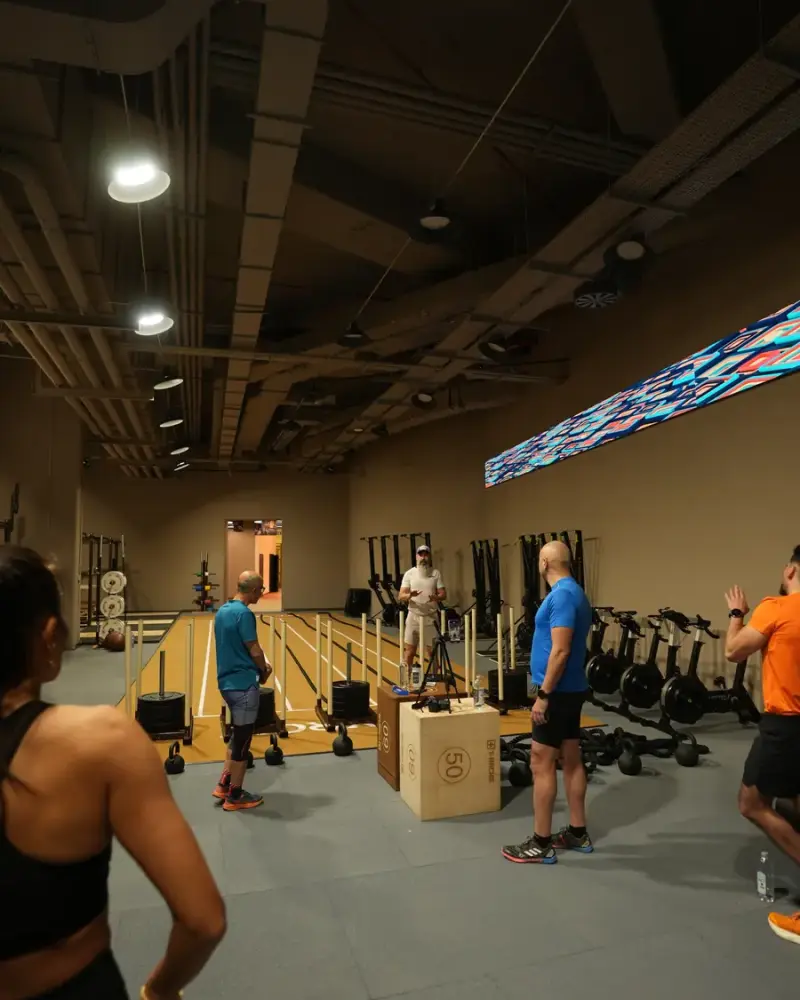
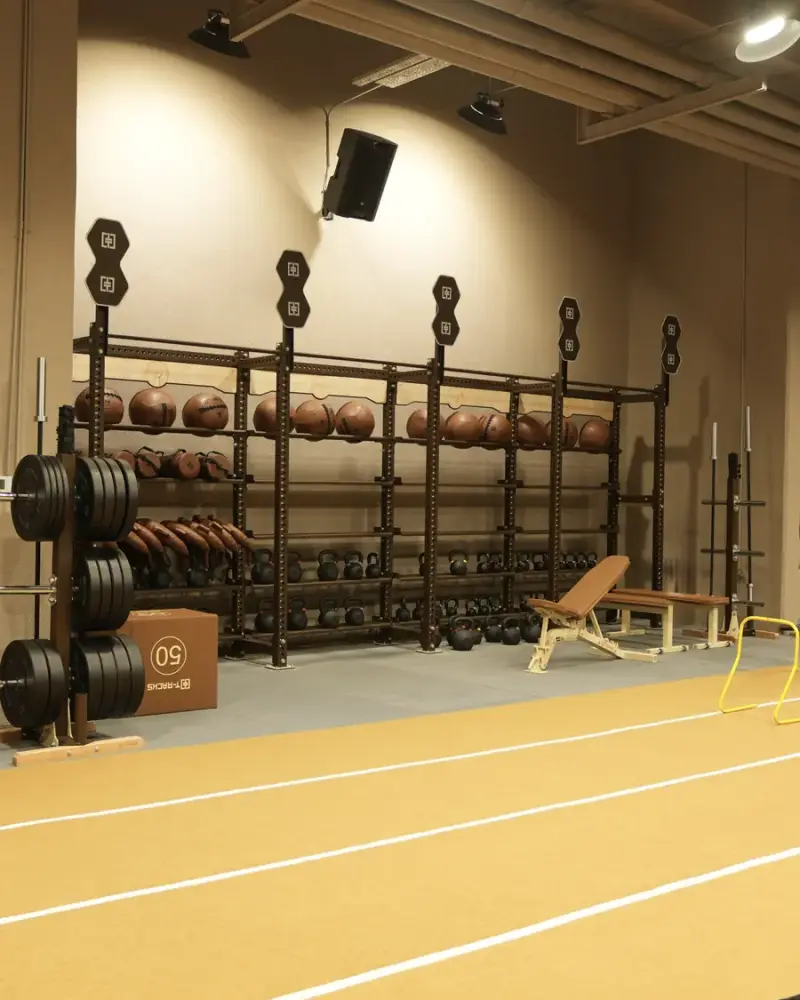
The core difference between HYROX and CrossFit can be summed up in one sentence: HYROX is standardized, CrossFit is variable. In HYROX, the same 8 kilometers of running and the same 8 stations in the same order await you anywhere in the world; in CrossFit, every workout and every competition presents different movements, different loads and a different time structure. This single distinction completely changes the training logic of the two sports, the skills required and who excels at which. Below we break the difference down into nine concrete headings.
1. Format: a fixed script or a surprise?
A HYROX race runs through this flow every time: 1 km run, 1000 m SkiErg, 1 km run, 50 m Sled Push, 1 km run, 50 m Sled Pull, 1 km run, 80 m Burpee Broad Jump, 1 km run, 1000 m Row, 1 km run, 200 m Farmers Carry, 1 km run, 100 m Sandbag Lunges, 1 km run, 100 Wall Balls. The order never changes. That's why weeks before the race you can write down the target time for each station on paper and rehearse that script over and over. A plan works because it's known.
CrossFit, by definition, involves “preparing for the unknown.” A WOD announced on competition morning might include muscle-ups, snatches, rope climbs or handstand walks. Preparation isn't polishing a single script but keeping a broad movement repertoire usable at any moment. In practice, that means “being a little ready for everything”; HYROX means “being very ready for one thing.”
2. Movement repertoire and technical load
HYROX's technical load is low. None of the stations require Olympic lifts or gymnastics skills. Apart from wall balls and sandbag lunges, there's no complex coordination challenge; the real difficulty is technique breaking down with fatigue. In other words, the learning curve is short and the application curve is long. Someone with no training history can perform all eight stations with acceptable technique in the first week.
What do you need to learn on the CrossFit side?
Movements like the clean and jerk, snatch, kipping pull-up, ring dip and handstand push-up are part of the standard repertoire, and most require months of technical work. A beginner scales most WODs; the sense of progress is sometimes tied to learning movements, sometimes to conditioning. The real question isn't which side is “harder” but which type of difficulty suits you. For a station-by-station breakdown, see the 8 stations guide.
3. Energy system: 90 minutes or 8 minutes?
For most athletes, HYROX is 60-120 minutes of work that leans heavily on the aerobic base. A significant part of the race is spent just below or around the lactate threshold. So the ability to “work at moderate-to-high intensity for a long time” is decisive. That's why low-intensity weekly volume carries a lot of weight in preparation; Zone 2 training it's the most neglected yet most efficient component of HYROX programs.
Classic CrossFit WODs, by contrast, usually finish in 5-20 minutes, often taxing the anaerobic system. Power output per rep is high and the recovery window is short. A CrossFit athlete can do tremendous work in 12 minutes; but holding the same rhythm at minute 70 requires an entirely different foundation. The reverse is true too: a HYROX athlete with a strong endurance base may fall short on power output in an intense 8-minute WOD.
4. The weight of running: HYROX’s hidden half
Half of HYROX is running. You run 8 kilometers in total, and each of those runs comes right after a station, with heavy legs and a high heart rate. This particular situation is called compromised running and it's at the heart of preparation. Someone who comfortably runs 5 kilometers in the gym can lose 40-60 seconds per kilometer on the 1 kilometer after the Sled Push; spread over eight runs, that loss alone adds up to 5-8 minutes.
In CrossFit, running appears as a component, but usually in 400-800 meter pieces. Weekly running volume rarely approaches the 20-40 kilometer range common in HYROX preparation. So the first six weeks of a CrossFit athlete moving to HYROX are spent largely building a running base.
5. Load philosophy: carry, push, pull — not lift
HYROX loads are fixed by category and have a “carry, push, pull” character. The table below puts the load logic of the two sports side by side.
| Heading | HYROX | CrossFit |
|---|---|---|
| Load type | Sled, sandbag, farmers handles, wall ball | Barbell, kettlebell, dumbbell, bodyweight |
| Load variability | Fixed by category | Different in every WOD |
| Maximal strength requirement | Moderate | High |
| Strength endurance requirement | Very high | High |
| Technique learning time | Days – weeks | Months – years |
| Movement order in the race | Fixed | Not known in advance |
In practice, this means: in HYROX, the time a 180-kilo deadlift buys you is limited, but being able to pull a 100-kilo deadlift for 20 reps pays off directly. We covered which strength movements have real carryover in detail in the strength training article.
6. Categories and comparability
HYROX has clear categories like Open, Pro, Doubles, Relay and Elite; each category's load and rules are known in advance. That's why the time you run in Istanbul can be compared directly with someone racing the same category in Hamburg. Results are kept in a single global database, and you can track your own progress in numbers across the years.
In CrossFit, comparison is only possible within the same WOD of the same competition. The Open rankings are formed with different movements every year; the sentence “I improved by 3 minutes over last year” doesn't carry the same meaning. If you want to settle on a category, review the categories comparison before registering.
7. What does a training week look like?
A typical week in the two sports looks nothing alike. The list below shows the six-day flow of an intermediate athlete preparing for HYROX.
- Monday: 45-60 minutes of low-intensity running, followed by 10 minutes of grip work.
- Tuesday: Lower-body strength (squat, Romanian deadlift, split squat) + 4 × 200 m farmers carry.
- Wednesday: Hybrid intervals: 6 rounds of 500 m run + 15 wall balls + 10 burpee broad jumps, 90 seconds between rounds.
- Thursday: Active recovery: 30 minutes of rowing or SkiErg, mobility routine.
- Friday: Sled block: 8 × 25 m push, 8 × 25 m pull, 200 m run in between.
- Saturday: Long session or half simulation: 4 km run + 4 stations, in race order.
A CrossFit week, by contrast, is usually built around a single daily class: technique work, a strength block and a 10-20 minute WOD. Volume planning depends more on the day's programming than on personal goals.
To put the difference in numbers: an intermediate athlete preparing for HYROX runs roughly 20-35 kilometers a week, does 4000-8000 meters on the ergometers, and limits strength work to two sessions. Total high-intensity work time in the same week mostly doesn't exceed 40 minutes; everything else is moderate and low intensity. On the CrossFit side, the number of high-intensity minutes is significantly higher and low-intensity volume is low. This single difference also separates the recovery needs of the two sports: in a HYROX program, protecting sleep and daily step count comes first; in a CrossFit program, protecting full rest between sessions does.
8. Which one suits whom?
Someone with an endurance background who likes running, enjoys holding a rhythm in repetitive work and wants measurable goals progresses quickly in HYROX. Those who love learning new skills, variety, explosive lifts and short intense sessions are happier in CrossFit. If you have a shoulder history that requires avoiding overhead lifting, HYROX's movement pool is more manageable; if you have such a limitation and the complaint persists, seeing a physician first is the right order.
Gym culture differs too. In a CrossFit box, the WOD of the day is a shared experience; everyone does the same work. HYROX training relies on a more individual plan: two athletes can work at different paces in the same session. On race day, HYROX requires focusing on your own clock in an indoor hall with wave starts; even positioning yourself in the crowd is a skill to learn.
At Hybrid Sky, we carry this distinction into session design: technique quality is measured, pace is set by individual threshold, and the weekly block is built around the race calendar. To see the flow, the class schedule, and to compare session types, the classes page take a look.
9. Is it possible to do both?
It's possible, but choosing a priority is essential. A simple rule that works for someone who wants to prepare for HYROX while continuing CrossFit: dedicate at least two sessions a week to pure running and one session to station-specific work, and cut the number of WODs to three. Otherwise both running volume and recovery fall short, and progress stalls in both sports. For the rules on fitting strength and endurance into the same week without conflict, the hybrid training article is a good start. When deciding, remember: the two sports have a lot in common, but keeping one goal at a time speeds up progress.
A practical transition scheme works like this: for the first four weeks, maintain your CrossFit volume and add just two easy runs; from week five, replace one WOD with a station-specific block; in week nine, do your first half simulation and write the remaining eight weeks based on the weak link it reveals. For those who progress in this order, joint load stays under control and strength is maintained without losing running economy. In the other direction, for those moving from HYROX to CrossFit, priority goes to technique learning; conditioning is already there, what's missing is movement quality.
Do I need CrossFit experience to start HYROX?
No. HYROX stations are technically easy to learn; you can establish the basic standards in a few sessions. A CrossFit background is an advantage, but running volume still has to be built from scratch.
How hard is HYROX for a CrossFit athlete?
They're usually comfortable at the stations and struggle on the runs. Because they aren't used to 8 kilometers in total and running on tired legs, most of the time in their first race is lost on the running course.
Which is more effective for weight loss?
Both burn a lot of energy; what decides it is weekly consistency and nutrition. Because HYROX sessions are longer, total energy expenditure is usually higher.
Are there Olympic weightlifting movements in HYROX?
No. The snatch and clean and jerk aren't part of the race format. The stations are built around pushing, pulling, carrying, lunging and wall balls.
A stronger version of you.
Just one step away.
24 hours from your first message to your first session. Let's build your program together — reach out on whichever channel suits you.
Weekdays 06:00 - 23:00