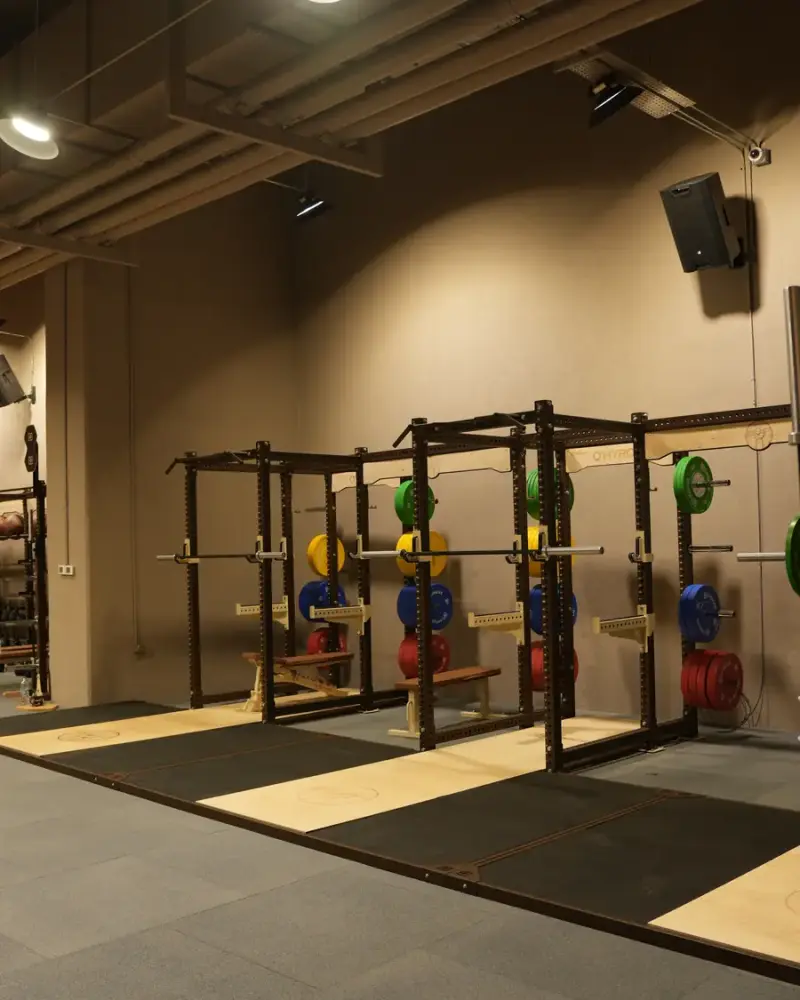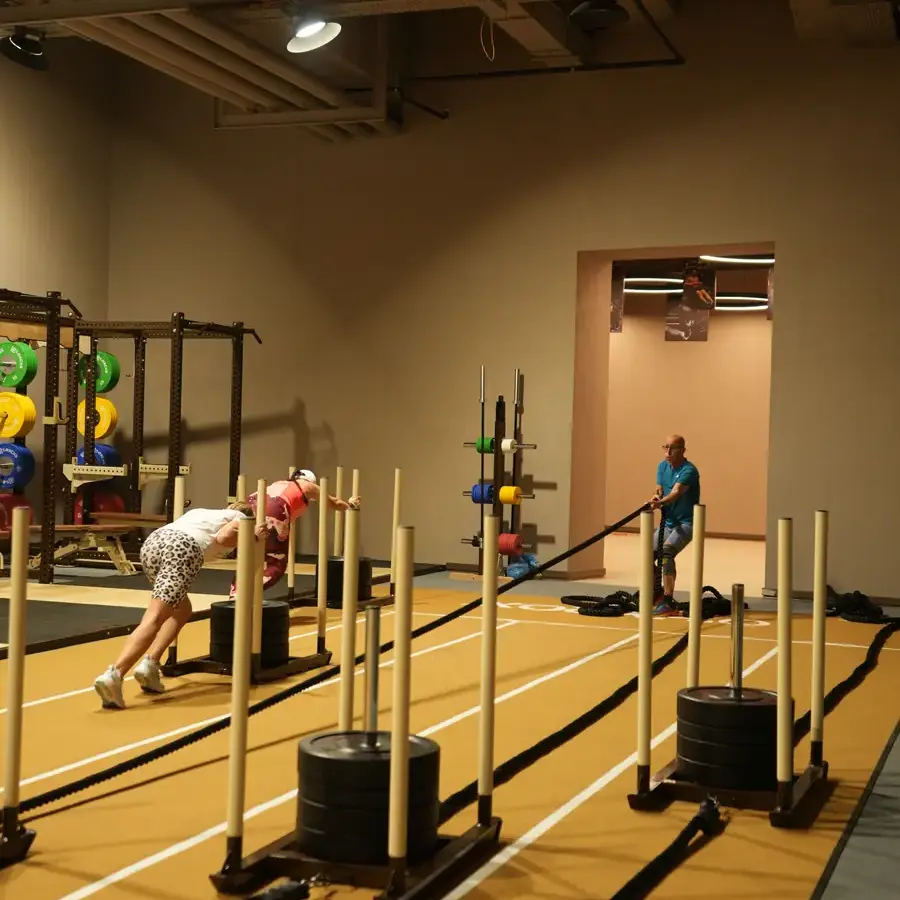
HYROX stations are eight functional tasks placed in a fixed order between 8 kilometers of running: 1000 m SkiErg, 50 m Sled Push, 50 m Sled Pull, 80 m Burpee Broad Jump, 1000 m Row, 200 m Farmers Carry, 100 m Sandbag Lunges and 100 Wall Balls. Each station has its own technique, a load that varies by division and a strategy that requires finding the right pace within the race. This guide covers all eight one by one while also showing the links between them; because in HYROX, how you finish one station determines how you enter the next.
The eight stations at a glance: order, task and the quality they test
Let’s first look at the big picture. The order never changes from race to race, and it isn’t random: it starts with an upper-body-dominant erg, followed by two leg-burning sleds, an explosive movement in the middle that sends your heart rate through the roof, then another erg, and finally carrying, lunging and throwing under fatigue. The table below summarizes what each station demands.
| Order | Station | Work | Key quality | Typical mistake |
|---|---|---|---|---|
| 1 | SkiErg | 1000 m | Upper body and core endurance | Pulling with the arms only |
| 2 | Sled Push | 50 m | Leg strength, torso angle | Trying to push the sled while standing upright |
| 3 | Sled Pull | 50 m | Back, hips, grip | Pulling with the arms and not letting the rope fall to the floor |
| 4 | Burpee Broad Jump | 80 m | Recovery capacity, rhythm | Starting too fast in the first 20 meters |
| 5 | Row | 1000 m | Leg drive, aerobic capacity | High damper, low efficiency |
| 6 | Farmers Carry | 200 m | Grip, core stability | Setting the load down unnecessarily |
| 7 | Sandbag Lunges | 100 m | Single-leg endurance | Missing knee contact and getting no-repped |
| 8 | Wall Balls | 100 reps | Leg and shoulder endurance, breathing | Going until you’re spent and then taking a long break |
Loads differ between the Open and Pro divisions, and also between the women’s and men’s categories; sled weight, Farmers Carry kettlebells, sandbag and wall ball weight are set by division. You can find the exact weights in detail in our Open and Pro weights comparison table . In this article, we approach load not in kilograms but in terms of how hard the station feels.
First half: SkiErg, Sled Push and Sled Pull
1. SkiErg (1000 m)
The SkiErg is the first station of the race, and most athletes arrive with fresh legs and high motivation. That’s exactly the trap. On the SkiErg, power comes not from the arms but from the hip hinge and the downward crunch of the torso. The arms complete the chain but they are not the engine. Keep your arms slightly bent at the elbows, start the handles high, close the torso forward by pushing your hips back and bring the handles down to just below thigh level.
Strategically, the SkiErg should be taken a little more conservatively than the rest of the race. The few seconds gained here are insignificant next to the minutes lost on the Sled Push. For damper settings and stroke rate, see our SkiErg damper and stroke rate guide for more.
2. Sled Push (50 m)
The Sled Push is the station most racers fear most. The 50 meters are usually completed as 4 lengths of 12.5 meters. Keep your arms extended or slightly bent, lean your torso at roughly a 45-degree angle to the floor and drive the floor with the balls of your feet in short, quick steps. If the sled stops, getting it moving again takes much more energy; so slow but continuous movement is almost always better than starting fast and stopping often.
3. Sled Pull (50 m)
In the Sled Pull, you pull the sled toward you with a rope. By rule, you must stay behind a designated area. The effective method is to sit your hips back, lean your torso back and let the rope fall in front of you as you pull hand over hand. Pulling with your arms alone quickly drains your forearms and grip; you pay the price in the Farmers Carry. For technique details, see our Sled Pull technique article you can read about.
Mid-race: Burpee Broad Jump and Row
4. Burpee Broad Jump (80 m)
At this station, your chest touches the floor, you stand up and jump forward with both feet. 80 meters means 30 to 50 reps for most athletes. What decides it here is rhythm, not strength. Taking the first 20 meters under control and settling into a rhythm is much more efficient than stopping in the last 20 meters. Overdoing your jump distance burns your legs early; aim for a medium, repeatable jump. Keeping your hips high as you lift your chest off the floor and bring your feet toward your hands saves a little energy on every rep.
5. Row (1000 m)
The Row sits right in the middle of the race, and many athletes see it as a chance to rest. That’s partly true: with the right technique, rowing can keep your heart rate in check while also giving your legs active recovery. About two-thirds of the power comes from the legs. The sequence is always legs, body, arms; and on the return, arms, body, legs. Setting the damper too high lowers efficiency on tired legs, especially after the Sled Push and Burpee Broad Jump. Finishing the 1000 meters at a steady split and picking up slightly in the last 200 meters is a common and safe approach.
Second half: Farmers Carry, Sandbag Lunges and Wall Balls
6. Farmers Carry (200 m)
A 200-meter walk with two kettlebells. The technique is simple; the challenge is grip. Pull your shoulders back and down, keep your torso upright and walk with short but quick steps. Every time you set the kettlebells down, it costs a few seconds plus the cost of picking them up again. For most athletes, the goal is to finish with at most one or two breaks. Your grip is already fatigued from the Sled Pull and Row that come before this station; it’s important to simulate this in training.
7. Sandbag Lunges (100 m)
The sandbag is carried on the shoulders, and the back knee touches the floor on every step. This station is one of the places in the race where the most no-reps are given. Keep your stride length consistent, keep your torso upright and make sure your back knee touches the floor on every step. Shortening your steps to gain speed is tempting, but very short steps put unnecessary load on your knees and hips. Building a pace synced with your breathing, without breaking rhythm, gives better results than sudden surges.
8. Wall Balls (100 reps)
The final station of the race and often the one you spend the longest on. You throw the ball to a set height, driving up from full squat depth. Doing all 100 reps unbroken isn’t realistic for most athletes; so pre-planned sets (for example four sets of 25 or five sets of 20) and short, fixed breaks are the most efficient route. Tie your breathing to the throw: inhale on the way down, exhale as you release the ball. For detailed split schemes, take a look at our Wall Ball 100-rep strategy article.
Links between stations: cumulative fatigue
You need to think of HYROX not station by station but as a chain. Each station affects the next:
- SkiErg → Sled Push: A torso overloaded on the SkiErg struggles to hold the right angle while pushing the sled.
- Sled Pull → Farmers Carry: Pulling with the arms drains your grip and leads to dropping early in the carry station.
- Burpee Broad Jump → Row: Legs tired from the jumps reduce your drive power on the rower.
- Sandbag Lunges → Wall Balls: Quads exhausted by the lunges make the wall ball squat as hard as it gets.
- Each station → the next run: The first 200 meters out of a station are the most critical part of recovery.
That is why the 1 km runs between stations are not just distance but also recovery zones. To learn to run on tired legs, see our compromised running article is a good starting point.
Load and pace: how to prepare for the stations
Station performance has three layers: technique, strength and endurance under fatigue. All three should be trained separately and then combined.
- Technique: Station practice once or twice a week with low fatigue and light load. The goal is to make the movement automatic.
- Strength: Foundational strength with squats, deadlifts, lunges and pulling movements. This is what decides the sleds and lunges. We explained which movements work in our strength training for HYROX article.
- Endurance: Sessions combining running with stations. For example, short chains like a 1 km run + 500 m SkiErg + 1 km run + 25 wall balls.
As the race approaches, these three layers gradually merge, and in the final phase you do a realistic rehearsal of the race with a full or half simulation. You can find how to set up a simulation in our HYROX simulation guide . If you want to measure which station you are really weak at, the weak station analysis method makes the job easier.
Division, load and level: scaling the stations to you
For a beginner, not all eight stations feel equally hard. Athletes with a running background are usually comfortable on the SkiErg and Row but struggle with the sleds and wall balls. Those with a strength background push the sleds relatively easily but have trouble controlling their heart rate in the Burpee Broad Jump and running sections. That’s why you need to scale each station to your level in training.
A practical scaling approach: start technique work at about 60-70 percent of race weight and increase the load gradually once the movement becomes clean and rhythmic. On the sleds, you can split the distance before reducing the load; for example, instead of 50 meters, push 4 × 12.5 meters with rest in between. In wall balls, changing set size while keeping target height and ball weight constant is the safest way to increase volume without breaking technique.
The question of Open or Pro becomes important at this point. In the Pro division, the sleds, kettlebells, sandbag and wall ball are heavier; this difference noticeably lengthens your time, especially in the Sled Push and Sandbag Lunges. For most athletes, Open is a more sensible start for their first race. To clarify your division choice, take a look at our HYROX divisions comparison . In Doubles or Relay formats, the scaling logic is a little different because station work is shared: taking on more work at your strong stations and leaving the weak ones to your partner becomes part of the strategy.
Finally, keep a simple log to measure your progress at each station: time, load, number of breaks and the pace of the first kilometer after the station. Within a few weeks, these four data points clearly show which station is really improving and which one is holding you back.
Race-day station strategy
In a race, you should enter every station with a plan. The simpler the plan, the easier it is to execute. A practical approach is to answer these questions:
- At what pace will I do this station? (For example, a target split for the SkiErg.)
- Where will I take breaks? (Wall Ball sets, Farmers Carry drop point.)
- Which technical cue will I remind myself of? (Sled Push: short steps, low torso.)
- How will I run the first 200 meters after leaving the station?
Putting this plan on paper before the race and testing it at least once in training reduces your decision load on race day. Don’t forget that the transition area you pass through into and out of the stations, the Roxzone, is a time cost in its own right.
Station work at Hybrid
As a HYROX club inside the O’Wellness Sky complex, Hybrid lets you train all eight stations in one space. Technique-focused sessions, strength blocks and full simulations are part of the weekly program. You can find which class focuses on which station in on the classes page, and general information about the HYROX format in on the HYROX page . If you’re not sure which station to start with, a short assessment with a coach is the fastest route.
The basic logic of station work at the club is simple: first learn the movement correctly, then increase load and volume gradually, and finally combine it with running to mimic race conditions. If this order is skipped, technical errors grow under fatigue and lead to both lost time and unnecessary strain. If you want to plan your preparation block by block, you can review the weekly structure in on the program page . Rather than starting a program without measuring your level, doing a short test at a few stations to establish your starting point also makes it easier to track progress.
A final note: if you feel pain or a recurring discomfort at the stations, especially in your lower back, knees or shoulders, review your technique and see a doctor if the complaint persists. Completing all eight stations healthily is more important than any time goal.
Does the order of HYROX stations change?
No. The order is the same at every race in the world: SkiErg, Sled Push, Sled Pull, Burpee Broad Jump, Row, Farmers Carry, Sandbag Lunges and Wall Balls. This consistency makes it possible to rehearse the race in advance.
Which HYROX station costs the most time?
For most athletes, the biggest losses come at the Sled Push, Sled Pull and Wall Balls. That’s because the loads are heavy and you enter these stations on tired legs.
Should I train stations on their own or together with running?
Both. You need to train a station on its own for technique and strength, and combined with running for race realism. At least one session a week that includes running and stations together is recommended.
A stronger version of you.
Just one step away.
24 hours from your first message to your first session. Let's build your program together — reach out on whichever channel suits you.
Weekdays 06:00 - 23:00