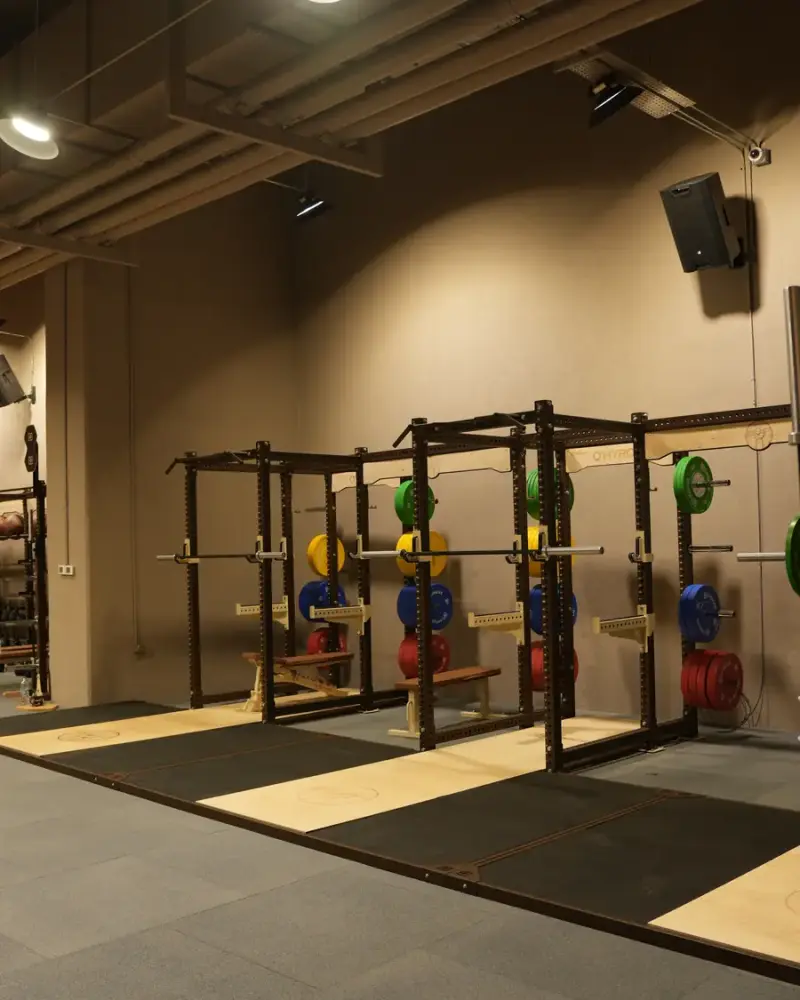
A HYROX simulation means doing all or half of the race sequence without stopping, on the clock, and at race loads. Its purpose isn't to build fitness; it's to test pacing, observe your roxzone habits, and learn whether your target time is realistic. A full simulation is done at most once or twice, no later than 5-6 weeks before the race; a half simulation can be repeated every 3-4 weeks. Below you'll find the protocol for both formats, a split target table, and a post-simulation analysis checklist.
Why simulate? The gap between training and racing
When you combine the eight stations you've trained separately, the resulting time is always longer than the sum of the parts. The difference comes from three places: time spent in transitions, accumulated fatigue carried into the next station, and the cumulative effect of pacing errors. A simulation makes these three items visible in a single measurement.
The second benefit is mental. Hitting 100 wall balls for the first time with 70 minutes of fatigue is a completely different experience from doing 100 wall balls fresh in training. Experiencing this for the first time on race day usually wrecks your time goal. We compiled the mistakes made in a first race in the mistakes made in your first HYROX race article.
Full simulation protocol: 8 km and 8 stations
A full simulation is identical to the race: it starts with a 1 km run, each run is followed by the next station, and the order never changes.
| Order | Work | Split for a 90 min target | Split for a 105 min target |
|---|---|---|---|
| Run 1 | 1 km | 4:30 | 5:15 |
| Station 1 | 1000 m SkiErg | 4:15 | 4:45 |
| Run 2 | 1 km | 4:45 | 5:30 |
| Station 2 | 50 m Sled Push | 2:45 | 3:30 |
| Run 3 | 1 km | 4:50 | 5:40 |
| Station 3 | 50 m Sled Pull | 3:15 | 4:00 |
| Run 4 | 1 km | 4:55 | 5:45 |
| Station 4 | 80 m Burpee Broad Jump | 5:30 | 7:00 |
| Run 5 | 1 km | 5:00 | 5:50 |
| Station 5 | 1000 m Row | 4:00 | 4:30 |
| Run 6 | 1 km | 5:00 | 5:55 |
| Station 6 | 200 m Farmers Carry | 2:15 | 2:45 |
| Run 7 | 1 km | 5:05 | 6:00 |
| Station 7 | 100 m Sandbag Lunges | 4:30 | 5:45 |
| Run 8 | 1 km | 5:00 | 6:00 |
| Station 8 | 100 Wall Balls | 6:30 | 8:30 |
A full rehearsal is hard to do alone, because setting up equipment between stations eats into your time. If possible, having a friend keep the clock and drag the sled back to the start line makes the rehearsal noticeably more realistic. If you're doing it alone, count setup tasks as transition time and make a note of it; those seconds will come back on race day.
The values in the table are approximate targets excluding transitions; allow a total of 4-8 minutes for the eight transitions. If you want to build splits for your own target, use the calculation method in the setting a target time article.
Half simulation: 4 runs, 4 stations
Because its recovery cost is much lower, the half rehearsal is the main tool of the preparation process. There are two setups:
- First-half rehearsal: 1 km + SkiErg 1000 m + 1 km + Sled Push 50 m + 1 km + Sled Pull 50 m + 1 km + Burpee Broad Jump 80 m. Tests the race's heaviest strength block. About 40-50 minutes.
- Second-half rehearsal: 1 km + Row 1000 m + 1 km + Farmers Carry 200 m + 1 km + Sandbag Lunges 100 m + 1 km + 100 Wall Balls. Tests fatigue management and wall ball endurance. About 42-55 minutes.
- Condensed half: All eight stations, but with 500-meter runs and half-distance station work. About 35-40 minutes; good for refreshing your memory of the order.
The second-half rehearsal is more instructive for most athletes, because races are usually lost there. If you want to set your Wall Ball splitting schemes in advance, the Wall Ball rep-splitting schemes article offers ready-made options.
When to simulate? Placement in a 12-week calendar
| Time to race | Simulation type | Goal |
|---|---|---|
| 12 weeks | Condensed half | Baseline reference, learning the order |
| 10 weeks | First-half rehearsal | Strength block test |
| 8 weeks | Second-half rehearsal | Fatigue management |
| 6 weeks | Full simulation | Target time validation |
| 4 weeks | Second-half rehearsal (at race load) | Pacing fine-tuning |
| 2 weeks | Condensed half, low intensity | Rhythm refresher |
| 1 week | No simulation | Taper |
Putting a full simulation within 2 weeks of the race is a common mistake: recovery takes 5-7 days and disrupts the taper. We explained how to structure the final two weeks in detail in the HYROX taper article. To fit the simulation into a 12-week plan, see the 12-week preparation program for more.
Simulation day rules: where does realism begin?
A rehearsal only works if conditions resemble the race. Five rules:
1. Use race loads. Whether you'll race Open or Pro, train with that division's loads. A rehearsal with a light sled produces a misleading time. The division differences Open and Pro loads you can compare in the table.
2. Don't stop the clock. Transitions, drinking water, tying shoes — it all counts. It will in the race, too.
3. Do it in your race outfit and shoes. A rehearsal is also an equipment test. A shoe that rubs or clothing that chafes will show itself within 90 minutes.
4. Test your race nutrition. Test your breakfast, gel timing, and fluid amounts in the rehearsal. Trying something new on race day is a risk.
5. Do it in the morning if possible. Rehearsing close to your race time also tests your digestion and wake-up routine.
Post-simulation analysis: which eight data points to record?
The value of a rehearsal is in the analysis afterward. As soon as the session ends, write down these eight items:
- Each run's split (8 values) and which run was slowest.
- Each station's time (8 values).
- Estimated total transition time and the longest transition.
- Number of breaks at stations (critical for wall balls and burpees).
- Average and maximum heart rate (if you have a chest strap).
- Fluid consumed and carbohydrates taken in.
- First breaking point: at which minute your pace dropped noticeably.
- Post-session RPE and muscle soreness level the next day.
Recording this data in the same format at every rehearsal ties your progress to numbers rather than feelings. We systematized what to record and how in the training log article; to look at the resulting table and find your weakest item, use the station analysis article.
Who isn't ready for a simulation yet?
A rehearsal is a powerful tool, but done at the wrong time it kills motivation and raises injury risk. Three prerequisites must be met before doing a full simulation:
- Being able to run 8 kilometers continuously. If you can't complete 8 kilometers at a reasonable pace without stations, the runs in the rehearsal turn into walks and the measurement loses its meaning. Build your running volume before crossing this threshold; for weekly volume recommendations, see weekly running volume article.
- Being able to complete each station on its own at race load. Especially 100 wall balls and 100 meters of sandbag lunges: if you can't finish them fresh, you won't finish them in the rehearsal.
- Eight weeks of consistent training. For an athlete just returning to a program or coming off a long break, a full rehearsal produces only fatigue, not adaptation.
If any of these three conditions is missing, start with a half simulation or a condensed half format. A more gradual entry path for beginners in the first 4-week beginner plan is explained there.
Another common situation: the athlete is physically ready but mentally treats the rehearsal like an exam. The purpose of a rehearsal isn't to get a grade, it's to collect data. A bad rehearsal gives you information you can fix six weeks before the race; a good one confirms your target time was set correctly. Both outcomes are equally valuable.
Recovery: how many days after a rehearsal?
A full simulation is as tiring as the race itself. What to do over the next 72 hours: day one, walking and light mobility; day two, an easy zone 2 run or row; day three, light strength. Wait 4-5 days before heavy strength or a new high-intensity session. After a half simulation, 48 hours is usually enough.
At Hybrid Sky, we hold in-club simulation races according to the calendar; having multiple athletes run under race conditions at the same time adds a realism you can't get rehearsing alone. The session types on the classes page, the weekly flow in the class schedule on its own page.
How many times should I do a full HYROX simulation?
Once, at most twice, in a 12-week preparation. Since the recovery cost is close to that of the race itself, repeating it often disrupts preparation.
Should I worry if my simulation is slower than my race time?
No. A rehearsal is usually slower than the race: crowd energy, the taper effect, and the official event flow shorten the time for most athletes on race day.
Can a half simulation replace a full rehearsal?
For learning pacing, largely yes, but only a full rehearsal shows the accumulated fatigue of the last three stations. Alternating the two is the most efficient approach.
Can I do a simulation if my gym doesn't have a sled?
You can, but the times won't be comparable. You can rehearse rhythm with alternatives like incline walking; validating a target time requires the real stations.
A stronger version of you.
Just one step away.
24 hours from your first message to your first session. Let's build your program together — reach out on whichever channel suits you.
Weekdays 06:00 - 23:00