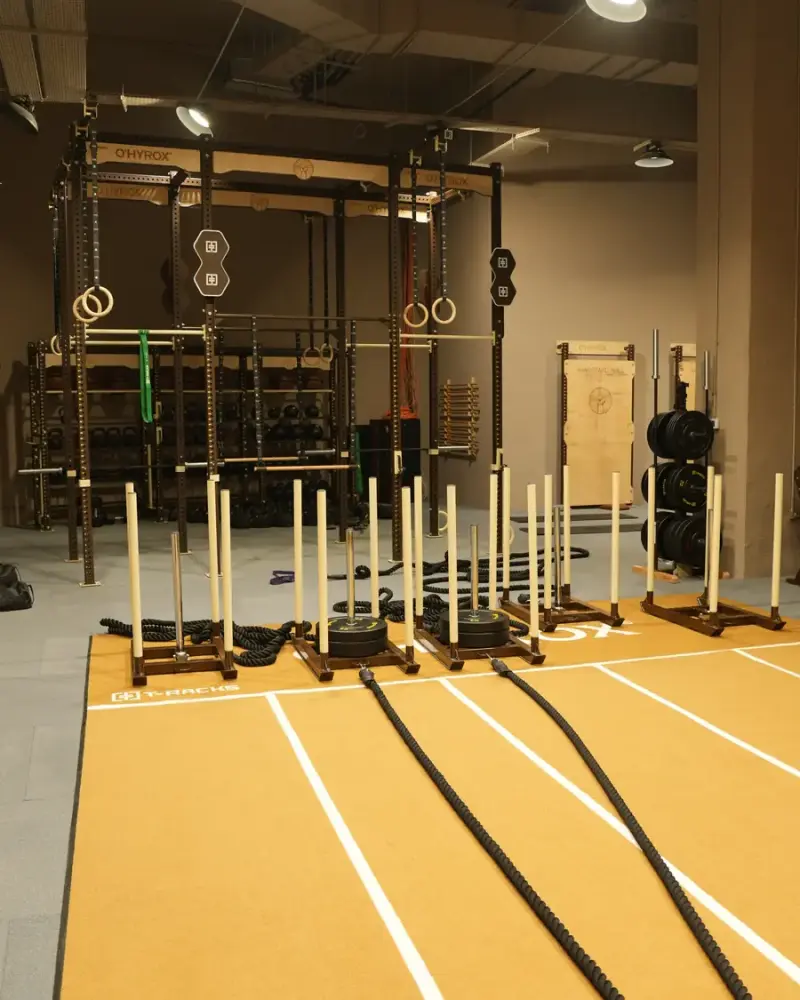
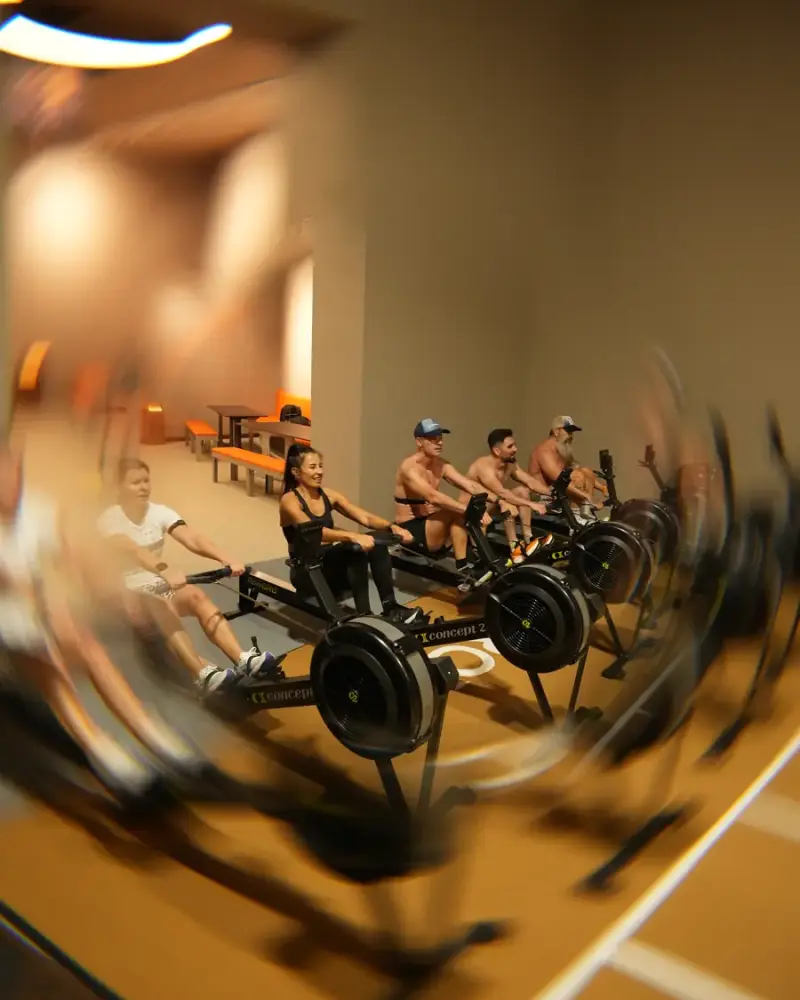
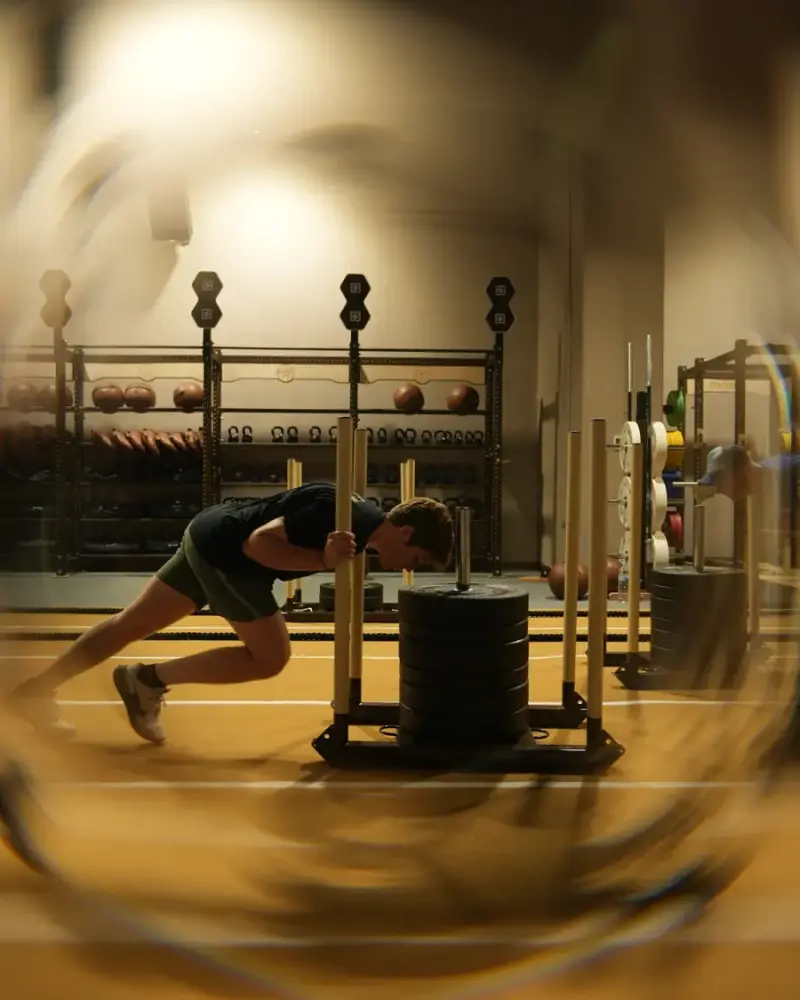
The HYROX area in the Sky complex is designed so that the eight stations of the race format can be performed in the same order and with the same work logic: an ergometer line, a sled lane, a carry-and-lunge strip and a wall ball wall. Because O’Wellness Sky is a complex that houses fitness and pilates, spa, padel and HYROX services together, the station, strength and recovery sides of preparation can all be covered in one facility. In this article we explain how the space is divided, which station is trained with which equipment, and what to look for when evaluating a HYROX area.
Why is the HYROX area divided into four zones?
In a race the stations are gathered in a central area, with the running course looping around it. A training space doesn't need to copy that layout exactly; what it needs is four functional zones that don't get in each other's way:
- Ergometer line — SkiErg and rower. Set side by side, with pace monitors facing where the coach can see them.
- Sled lane — a flat, rubber-floored lane for Sled Push and Pull. Used on an out-and-back basis.
- Carry and lunge strip — a measured open corridor for Farmers Carry, Sandbag Lunges and Burpee Broad Jump.
- Wall ball wall — a wall section with marked target heights where several athletes can work at once.
This zoning isn't just about tidiness. When eight people rotate through different stations in a group session, a sled lane crossing the carry lane costs both safety and time. Building the logic of the race's transition area, the Roxzone, into training as well naturally cuts your transition times.
Equipment inventory, station by station
| Order | Station | Race work | Equipment used in the space |
|---|---|---|---|
| 1 | SkiErg | 1000 m | SkiErg ergometer with adjustable damper |
| 2 | Sled Push | 50 m | Plate-loadable sled, rubber-floored lane |
| 3 | Sled Pull | 50 m | Sled + rope, pulling position area |
| 4 | Burpee Broad Jump | 80 m | Soft-floored strip with marked distance |
| 5 | Row | 1000 m | Rowing ergometer |
| 6 | Farmers Carry | 200 m | Kettlebells or farmers handles, carry corridor |
| 7 | Sandbag Lunges | 100 m | Sandbags in graded weights |
| 8 | Wall Balls | 100 reps | Balls of different weights, wall with height markings |
It's critical that the inventory isn't limited to a single weight. If someone doing Sandbag Lunges for the first time trains in the same session as someone preparing for the Pro division, one sandbag won't give either of them the right stimulus. The differences between Open and Pro loads in the full comparison table on its own page.
Flooring: the invisible part of the inventory
The most expensive and most decisive component of a HYROX area isn't the equipment but the floor. On the sled stations, friction determines your speed as much as the weight on the plates. The same 125 kg sled glides easily on a slick surface and almost stops on a sticky one. That's why a serious space solves the sled lane with a separate flooring material, and training loads are calibrated not by “how many kilos” but by “how many meters in how many seconds.”
Likewise, hard concrete on the Burpee Broad Jump strip puts unnecessary load on the knees and wrists, and a slippery carry corridor creates a balance risk when you're moving on tired legs. We covered the performance impact of these details from the technical side in the Sled Push technique and Burpee Broad Jump articles.
How is the running side handled?
Half of HYROX is running: 8 kilometers in total. In the training space this work is done in three ways. The first is the treadmill; it's the most measurable option for teaching pace control and holding rhythm on tired legs. The second is short shuttle runs in suitable areas within the complex; this comes closest to the feel of the race's looped course. The third is independent outdoor running blocks, where most of the volume usually falls.
We compared all three in the treadmill vs outdoors article. Why running on tired legs is a separate skill is explained in the compromised running article.
6 criteria for evaluating a HYROX area
- Station completeness: are all eight stations there, or are “similar” movements substituted?
- Lane length: are the sled and carry lanes long enough to keep the number of turns reasonable?
- Capacity: do you have to queue for an ergometer at busy times?
- Load scaling: are there separate weights for beginner and advanced levels at the same station?
- Measurement: are times and distances recorded, can you track progress?
- Coaching: are technical errors corrected on the spot?
The last two items make more difference than the equipment list. An unmeasured session is like an exam you took but never graded. Which data you should log in the training log article .
How does the rest of the complex tie into preparation?
Sky’s services beyond HYROX help carry the load of preparation. General strength and mobility work can be handled on the fitness and pilates side, recovery routines in the spa, and an active rest day with a low-key activity like padel. This isn't an “extra service”; it's a practical way to keep the weekly load balanced, because an athlete who only does HYROX sessions struggles to manage volume within four weeks.
We discussed the evidence on heat and cold therapies in the sauna and heat adaptation and cold water therapy articles. You can see all the services in the complex in this article.
If you're using the space for the first time
In the first session, the goal isn't to finish every station in one round; it's to measure where each station stands for you. A typical intro flow consists of a short warm-up, technique practice at four or five stations, and a short testing block at the end. The warm-up framework in the 12-minute warm-up routine, the level assessment in the HYROX level test in our running guide.
To see how the space works and how a day flows, check out the training day article, and for the format as a whole, our HYROX page . For current session times, capacity and participation terms, message us is the fastest route.
Capacity and session flow: how many people can the space handle efficiently?
A HYROX area's performance depends on the ratio of equipment to participants. In a space with two SkiErgs and two rowers, a group of ten works by rotating through the stations in a staggered way rather than all at once: the group splits into pairs, each pair starts at a different station, and they progress in fixed-time blocks. This setup doesn't reduce waiting to zero, but keeps it short enough that your heart rate doesn't crash.
In practice, three flow types are used. Station rotation: 3-4 minutes of work at each station, 45-60 seconds of transition; suited to technique learning and high-attendance sessions. Half simulation: four runs and four stations in race order; done once or twice a month as a test. Split block: the first half of the session is strength, the second half focuses on two stations; the most efficient format for targeting your weak link.
Which of these three suits you depends on how long you have until your race and your current base. When and how to do a simulation in the full and half rehearsal article, and the block logic in the program design article in more detail.
Four key metrics measured in the space
| Metric | Where it's measured | What it's for |
|---|---|---|
| Ergometer split time | SkiErg and rower monitor | Comparing aerobic progress over weeks |
| Sled pass time | Seconds per 12.5 m in the lane | Calibrating load to the floor |
| Wall ball split scheme | Number of sets and rest times | Planning the 100 reps for the race |
| Transition time | From station exit to run start | Making Roxzone losses visible |
The fourth line is the one most often skipped. Thirty seconds lost in each of eight transitions adds up to more than four minutes, which is more time than most athletes can gain in running pace over a whole season. The splitting schemes for the Wall Balls in the breathing management and rep-splitting article with examples.
The second benefit of a measuring habit is psychological. In HYROX prep, progress usually doesn't show in the mirror or on the scale; it shows in your 1000-meter SkiErg time dropping by fifteen seconds over eight weeks. That's why a simple log kept in the space is the most concrete tool for sustaining motivation. How to read the log and which trends are meaningful in the breaking plateaus article too.
Finally, when evaluating the inventory, don't expect a facility to have “everything.” What's critical for HYROX prep is the complete set of eight stations, progressive loads, and a measurable setup. Every machine added on top may be useful but isn't decisive. The list of strength movements that actually work in the strength training article, and to see the weekly flow the class schedule for more.
Does the HYROX area at Sky meet race standards?
The space is designed so that the eight stations can be performed in the same order and with the same work logic. No gym can match a race course exactly; what matters is preserving the character of the work.
Can I use the equipment freely?
Terms of use vary by session type. In group sessions, stations rotate according to the coach's plan. For open-use access and hours, you can get information from the contact page.
Where is the running done?
Running blocks can be done both on the treadmill and in suitable areas within the complex; part of the volume falls to independent outdoor runs.
I don't want to decide without seeing the space. What should I do?
Joining a session is the best option. Two spaces that look similar on paper can feel completely different because of flooring and lane length.
A stronger version of you.
Just one step away.
24 hours from your first message to your first session. Let's build your program together — reach out on whichever channel suits you.
Weekdays 06:00 - 23:00