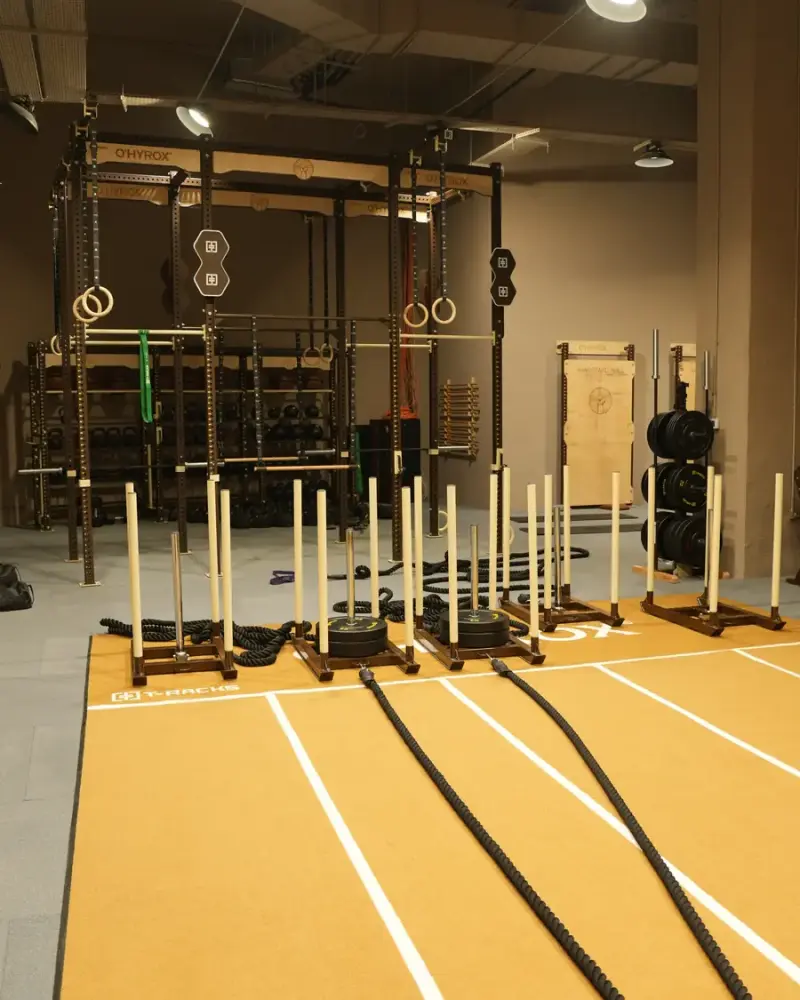
A typical HYROX session at Hybrid Sky lasts about 60 minutes and goes through six stages: check-in and prep, a 10-12 minute warm-up, a short technique block, the session's main work, cool-down and logging. The main work isn't a simulation every day; aerobic base, threshold work, strength and station technique are spread across different days of the week. Below we walk through a day minute by minute, along with what to bring and what to expect.
Before the session: 15 minutes and four decisions
The time from arriving at the facility to starting the warm-up has a surprising effect on session quality. Rushing in and going straight to the first station means spending the first ten minutes “waking up” instead of warming up. So preparation comes down to four simple decisions: choice of shoes, fluid intake, timing of your last meal, and which metric you'll track that day.
Shoes matter more in HYROX than people think, because in the same session you run, push and pull a sled and lunge. A running shoe with an overly soft sole costs you power on the Sled Push, and a very stiff lifting shoe is uncomfortable during running blocks. We covered the balance in detail in the shoe selection article . The list of what belongs in your bag is in the gear and clothing list .
The timing of your last meal is decisive, especially for evening sessions. A low-fat snack with a moderate amount of carbohydrate eaten 60-90 minutes before the session works well for most athletes; a heavy meal 20 minutes before causes stomach discomfort during wall ball and burpee blocks. The portion and timing framework in the pre-workout nutrition article in our running guide.
The first 12 minutes: why is the warm-up so long?
In HYROX prep, a warm-up isn't “walking on the treadmill for a few minutes and stretching.” In a session the shoulders, hips and ankles are stressed in three different ways: SkiErg and wall balls demand overhead range of motion at the shoulder, Sled Push demands deep dorsiflexion at the ankle, and Sandbag Lunges demand controlled single-leg loading at the hip. Preparing these three areas takes 10-12 minutes, and that time directly improves the session's effectiveness.
A typical warm-up has three layers: 3-4 minutes of easy erg or running to raise your heart rate, a 4-5 minute dynamic block to open up range of motion, and then 3 minutes of prep specific to that day's main set. The last layer is critical; the warm-up for a rowing-heavy session isn't the same as for a sled-heavy one. The template in the 12-minute warm-up protocol, regional mobility in the mobility routine is laid out there.
Technique block: what are the day's 8 minutes spent on?
After the warm-up comes a short technique block. The goal here isn't to get tired but to improve the quality of a movement you'll repeat a lot that day. For example, on a rowing day the sequencing error gets fixed: when the legs-body-arms order breaks down, you lose close to ten seconds over 1000 meters. On a wall ball day, the catch height and breathing rhythm are drilled.
Experienced athletes don't skip this block either, because technical errors come back with fatigue. Doing a movement correctly while fresh isn't skill; doing it correctly while tired is. The sequencing on the rowing side in the 1000-meter rowing strategy, and the SkiErg side in the SkiErg technique article in more detail.
Main work: four formats that change with the day of the week
- Aerobic base day. 35-45 minutes of continuous running or ergometer work at a conversational pace. It's boring, but this day builds the foundation of the season. We explained the logic in the Zone 2 training article .
- Threshold/interval day. Blocks such as 4-8 × 800 meters or 6 × 3 minutes, with short recovery in between. This is where you learn race pace. The templates in the interval article.
- Strength day. Squat, deadlift or single-leg variations plus accessory pulling work. The rep range is usually 5-8, with the goal of power production.
- Station/hybrid day. The day closest to the feel of a race, with running and stations interwoven. Half simulations are done here.
You don't have to fit all four into one week. Someone training three times a week progresses well enough with an aerobic base day, a strength day and a hybrid day. The breakdown by number of days in the days-per-week article is laid out in a table.
The session's toughest 10 minutes and how to manage them
| Block | Typical duration | Target rating of perceived exertion (RPE) | Watch out |
|---|---|---|---|
| Warm-up | 10-12 min | 3-4 | Start sweating, don't get tired |
| Technique block | 6-8 min | 4-5 | Quality, not speed |
| Main work | 25-35 min | 7-9 | Even if pace drops, don't let form break down |
| Finisher | 4-6 min | 8-9 | Short, controlled, planned |
| Cool-down | 5-8 min | 2-3 | Bring heart rate down, log your session |
The RPE scale is the most practical tool for those without a heart rate strap. The target in the main work is 7-9; finishing every session at 10 doesn't produce progress, it produces recovery debt. How to use the scale in the RPE article in more detail.
Cool-down and logging: the last 8 minutes of the session
The cool-down is the most skipped yet lowest-cost part of the session. Five minutes of easy ergometer work or walking brings your heart rate down gradually; then three minutes of targeted stretching, especially for the front of the hips, calves and chest, reduces the tightness you'll feel tomorrow. The routine in the post-session routine article is laid out there.
Logging takes two minutes, but it's the habit that makes the biggest difference over eight weeks. What to note is simple: what the main set was, the load or pace used, perceived exertion, and any sign of pain. These four lines are the only reliable way to understand what changed during a plateau. What you should log in the log article .
After the session: the first two hours
Two things matter in the first two hours after a session: restoring fluid-electrolyte balance and eating a meal that contains protein. We know the “anabolic window” story is overblown; total daily protein intake is more decisive than timing. Still, skipping a meal entirely after an evening session makes recovery harder the next day. The topic in the post-workout nutrition article too.
The spa inside the Sky complex can be used for passive recovery after a hard hybrid day. The evidence on when heat and cold therapies help is debated; in a block aimed at strength adaptation, a post-session ice bath isn't the preferred choice. Details in the cold water therapy article in our running guide.
What changes if it's your first session?
The first session is a simplified version of the flow. The main work is shortened, loads are kept low, and the goal isn't to get tired but to learn some of the eight stations with correct technique. Most people say after their first session, “It wasn't as hard as I expected, but my legs were sore for two days”; that's normal and settles within two or three sessions. Why muscle soreness happens in the DOMS article .
We gathered the details of first-day prep in the article on what to expect at Sky; you can review the session types on the classes page and see the weekly flow in the class schedule . For participation terms and current times, you can message us.
How are the days sequenced across a whole week?
Knowing the flow of a single day isn't enough; how the days are arranged relative to each other matters as much as session content. The basic rule: two high-intensity days don't go back to back, the strength day isn't placed right before the hybrid day, and the long easy run goes not on the most rested day of the week but on the most flexible one. The reason is simple: an easy run can be done when tired, but a threshold session done when tired doesn't deliver the intended stimulus; it just adds fatigue.
For someone training three times a week, a sequence that works is: strength on Monday, a hybrid station session on Wednesday, a long run on Saturday. With four sessions, a threshold day goes in between and lands on Friday evening. Beyond five sessions, a second strength day or a second aerobic day is added; at that point tracking recovery becomes mandatory, because the benefit of increased volume is realized only if sleep and nutrition are in place.
The effect of sleep on performance in the sleep and performance article, the early warning signs of overreaching in the overtraining syndrome article . The current framework on the interference effect, that is, how much strength and cardio done on the same day hinder each other, in this article in our running guide.
Fitting the program into an eight- or twelve-week block makes more of a difference than daily session quality. That's because progress in HYROX comes not from a single hard session but from consecutive weeks with gradually increasing intensity. How the block is built in the 12-week preparation program, when to pull back the load in the deload week article in more detail.
How long does a session last?
A typical HYROX group session is around 60 minutes including warm-up and cool-down. Days with a half or full simulation naturally run longer.
How many minutes early should I arrive?
15 minutes is enough to change and do a short movement prep. If it's your first session, allowing 20-25 minutes is more comfortable.
Is a full simulation done in every session?
No, and it shouldn't be. A full simulation is done once or twice a month as a planned test; the rest of the week is devoted to aerobic base, threshold work, strength and technique blocks.
Can people of different levels train in the same session?
Yes. Distances and loads are scaled. Working at the same station with different weights and rep targets doesn't disrupt the structure of the session.
A stronger version of you.
Just one step away.
24 hours from your first message to your first session. Let's build your program together — reach out on whichever channel suits you.
Weekdays 06:00 - 23:00