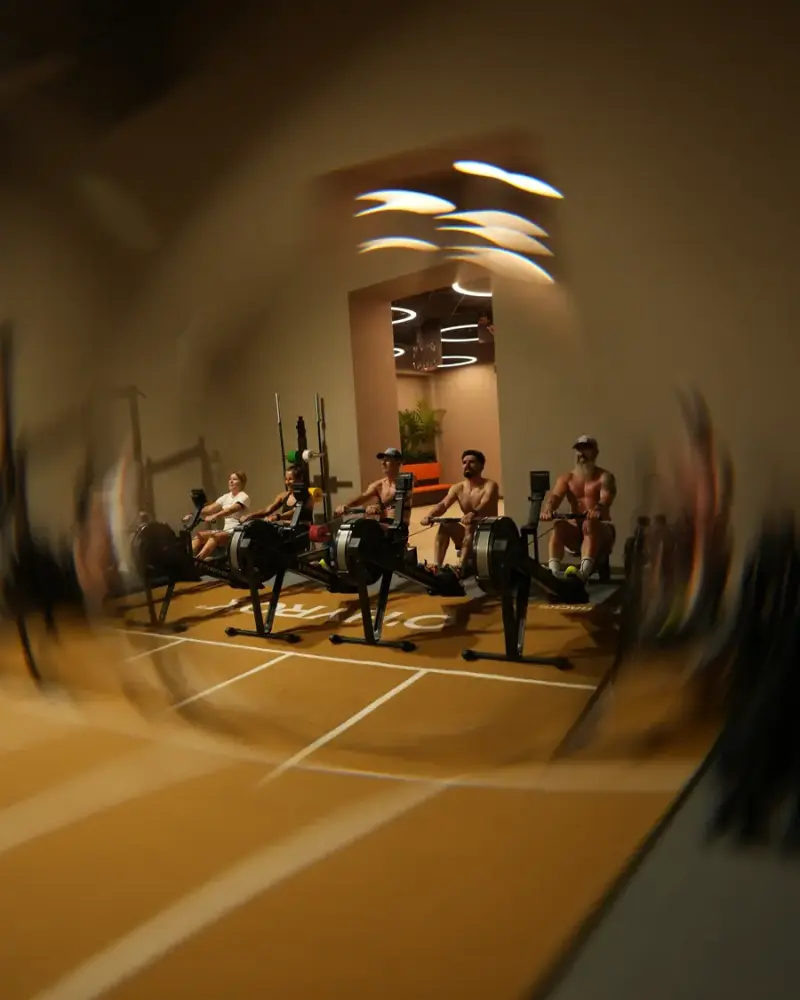
The secret to managing the 8 kilometers in HYROX well is to see it not as a straight 8 km run but as eight separate 1 km runs, each starting with a different kind of fatigue. Success rests on three foundations: a broad aerobic base, the ability to run on tired legs (compromised running) and consistent pacing from start to finish. Since more than half of total race time is spent running for most athletes, small improvements in running translate directly to your finish time. This guide brings together the physiology of HYROX running, training methods and in-race strategy.
Why is HYROX running different from a straight 8 km?
In an 8 km road race, the body finds its rhythm in the first kilometers and then tries to sustain it. In HYROX, that rhythm is broken every kilometer. After each 1 km, you enter a station, work different muscle groups intensely and then head back out onto the running course. This cycle repeats eight times.
This has a few important consequences. First, the first few hundred meters out of a station are a transition period where the legs feel heavy and coordination feels off. Second, because heart rate stays high throughout the stations, the opportunity to recover while running is limited. Third, in the second half of the race, especially after the Sled Push, Burpee Broad Jump and Sandbag Lunges, leg fatigue noticeably slows running pace.
That's why preparing for HYROX running isn't just about becoming a faster runner. It's about becoming a more durable, more economical runner who can hold form under fatigue. To see how running and the stations connect, HYROX stations guide take a look.
Aerobic base: the foundation of everything
In terms of energy systems, HYROX is predominantly an aerobic race. Although the stations momentarily tax the anaerobic system, the total duration of 60-120 minutes shows that aerobic capacity is decisive. A broad aerobic base lets you run faster at a lower heart rate, recover faster between stations and fall apart less at the end of the race.
The most effective way to build an aerobic base is to do most of your weekly running volume at an easy pace. This pace is often called “Zone 2”: an intensity at which you can talk comfortably and sustain with nasal or controlled breathing. For many athletes, this pace is much slower than they expect, which can be frustrating at first. But the purpose of easy runs isn't speed; it's developing the capacity of the cardiovascular system and muscles to use oxygen. For details, see our Zone 2 training article for more.
Another benefit of easy runs is that they contribute to recovery. A HYROX athlete who does two or three hard sessions a week both builds volume and moves the legs without straining them by running easy on the days in between.
Types of running sessions and their place in the week
A balanced HYROX running program combines several session types at different intensities. The table below shows the most commonly used session types, their purpose and example structures.
| Session type | Goal | Example structure | Weekly frequency |
|---|---|---|---|
| Easy running (Zone 2) | Aerobic base, recovery | 30-60 min at conversational pace | 2-3 |
| Tempo / threshold run | Raising lactate threshold | 3 × 8 min at threshold pace, 2 min easy between | 1 |
| Intervals | VO2 max and speed | 6 × 800 m, equal-time easy recovery | 0-1 |
| Compromised running | Running on tired legs | 4 rounds: 1 km run + one station | 1 |
| Long run | Endurance, mental patience | 60-90 min easy pace | 0-1 |
You don't have to cram all these sessions into the same week. For a beginner, two easy runs, one tempo session and one compromised running session a week are often enough. More experienced athletes can add intervals or a long run. What matters is putting enough recovery between hard sessions and planning well around overlaps with strength training.
For detailed protocols of tempo and threshold runs, see in the tempo run article, and for short interval options, in our 400 and 800 meter intervals article in our running guide.
Keeping easy runs truly easy is the most often neglected rule of the program. Many athletes run easy days at a moderate pace and then can't go fast enough on hard days; in the end, every session turns the same shade of gray. Keeping heart rate and breathing under control on easy days, and saving the energy needed to really push on hard days, significantly increases the effectiveness of your weekly program. A simple check is to see whether you can speak in full sentences during an easy run. If you can't, slow down.
Compromised running: learning to run on tired legs
Compromised running is the practice of running immediately after a station or strength exercise. It's the most important running skill specific to HYROX, because none of the eight runs in the race starts on fresh legs.
The goal of these sessions is to learn to quickly recover form and pace in the first few hundred meters out of a station. In early attempts, most athletes notice their legs feel “like concrete” after the Sled Push or Sandbag Lunges, their stride shortens and their pace drops significantly. With regular practice, this transition period gets shorter.
A simple compromised running session might look like this:
- 10-15 minutes of easy warm-up and dynamic mobility.
- 1 km run at target race pace.
- 20 meters of sled push or 20 walking lunges.
- 1 km run, focusing on regaining form in the first 200 meters.
- 20 wall balls.
- 1 km run.
- After completing 3-4 rounds of this cycle in total, a 10-minute easy cool-down.
These sessions are tiring; one a week is usually enough. For details on this topic, see in our compromised running article in our running guide.
Running economy and form
Running economy is the amount of energy you use while running at a given pace. A more economical runner sustains the same pace with less energy, and in a long, repetitive race like HYROX, this difference compounds. Factors that affect economy include stride frequency, foot strike, torso posture, arm swing and overall strength level.
Under fatigue, form usually breaks down like this: the torso collapses forward, strides get longer and heavier, the arms tense up and the shoulders rise. Simple cues help counter this:
- Torso: An upright but relaxed posture, with a slight forward lean coming from the ankles, not the hips.
- Stride: Short, quick steps, landing with your foot close to beneath your body.
- Arms: Elbows at about 90 degrees, hands relaxed, arms swinging front to back.
- Breathing: Rhythmic and deep; a few long exhales out of a station help bring your heart rate down.
Strength training also contributes to running economy. Single-leg strength and stronger calf and hip muscles in particular make it easier to maintain form under fatigue. If you're curious about the effect of stride frequency, check out our cadence article you can read about.
Pacing within the race
The most common running mistake in HYROX is running the first kilometer too fast. Start-line excitement, crowds and fresh legs lead to a first kilometer noticeably faster than the planned pace. These gains in the first few minutes are usually paid back several times over in lost time in the second half of the race.
A healthier approach is to deliberately keep the first run a bit controlled and keep your kilometer splits as close to one another as possible through to the end of the race. For most athletes, the final runs slow down a bit anyway due to fatigue; the goal is to minimize this slowdown. As a practical rule, your first kilometer shouldn't be much faster than your race average.
Using a watch to track pace during the race is helpful, but GPS data may not be reliable indoors. That's why perceived exertion and breathing rhythm are the most reliable guides in a race. For how to plan your pacing, see in the pacing strategy article, and for calculating target times per kilometer, in our target time article too.
Another practical tip is to divide the race into three parts from a running perspective. The first three runs are the control section: hit your pace and don't overdo it. Runs four through six are the patience section: hold your form as fatigue builds. The last two runs are the section for using your remaining energy. This simple framework gives you a clear mental map of when to hold back and when to let go during the race.
Crowding on the running course is also a factor. Slowing down at tight turns and at station entrances and exits is inevitable. Rather than needlessly speeding up and slowing down at these points, it's more efficient to go with the flow and find your pace again on the straights.
Weekly volume, injury and progression
Increasing running volume is one of the most reliable ways to improve HYROX performance, but it can also increase injury risk. Especially for strength-dominant athletes with little running background, tendons and bones take longer to adapt than muscles. That's why it's important to increase volume gradually and plan recovery weeks that reduce load every few weeks.
As a general approach, increasing weekly running volume in small steps each week and reducing volume for a week after three or four weeks of increases is a safe path for most athletes. Learning to distinguish pain from muscle fatigue is also a critical skill: general muscle soreness that passes within a few days is normal, but sharp, increasing or days-long pain at a specific spot is a warning sign. If such a complaint persists, reduce running and see a doctor.
For a more detailed discussion of how much running volume is enough, see the weekly running volume article take a look. We've also compiled the basic habits for preventing running injuries in our injury prevention article.
Treadmill, outdoors and different backgrounds
Where to do your runs is also an important decision in HYROX preparation. The treadmill makes pace control easier, is independent of weather and is a practical solution in sessions combined with stations. But because the belt moves the ground for you, it feels a bit different from outdoor running. Also, HYROX courses have frequent turns; you can't practice these turns and acceleration-deceleration cycles on a treadmill. The ideal approach is to use both: controlled tempo and interval sessions on the treadmill when needed, and easy and long runs outdoors. For the pros and cons of the two options, the treadmill or outdoors article .
An athlete's background also shapes how run training should be built. Athletes with a marathon or road-running background are usually strong aerobically; what they really need is strength work and practice running after stations. Those coming from strength sports, weightlifting or bodybuilding feel comfortable at the stations but have to devote more time to running volume and aerobic capacity. Athletes from team sports have an edge in quick acceleration and changes of direction, but they may need to learn separately how to hold a steady pace for a long time.
Whichever group you come from, the most important step in the first few weeks is to measure your current level honestly. Can you run comfortably for 30 minutes at an easy pace? After running 1 km at race pace, how long does it take your heart rate to recover? How much does your pace drop in the first 200 meters after a station? The answers to these questions set the focus of your program. As you decide how to mix easy runs and speed sessions, repeating these initial measurements every few weeks lets you see your progress in concrete terms.
When it comes to equipment, keeping it simple is best. A well-fitting shoe that still feels comfortable on tired legs, clothing that doesn't hold sweat and, if needed, a watch or chest strap for heart rate monitoring are all you need. When choosing shoes, consider not only running but also grip and stability at stations like the sled and lunges.
Running training at Hybrid
At Hybrid, run training isn't treated separately from station and strength work. Engine, running and erg-focused sessions build your aerobic base and sense of pace, while simulations let you test the combination of running and stations under conditions close to a real race. The club's location in Sarıyer also makes it possible to combine outdoor runs with nearby routes such as Belgrad Forest or the Bosphorus shore; use a map app for routes and directions, and for up-to-date information contact page .
You can see which classes focus on running on the classes page here. If you don't know where to start with running, a short level test to measure your current aerobic capacity and pace is the easiest way to start your program at the right point. Managing 8 kilometers isn't learned overnight; but with a consistent weekly structure, patient volume increases and race-specific practice, you become a little more economical and a little more durable every week.
How many kilometers a week should I run for HYROX?
It depends on your level and goal. Most beginners can build a good foundation with roughly 15-25 km per week; those with more ambitious goals increase volume gradually. Keeping weekly increases small reduces injury risk.
In HYROX, is running or are the stations more important?
Usually more than half of the total time is spent running, so running matters a lot. But being able to run well after leaving the stations depends on finishing the stations efficiently; the two should be trained together.
Is training on a treadmill enough?
The treadmill is useful for pace control and independence from the weather. But for turns, surface and a real feel for pace, it's good to do at least one session a week outdoors or on an indoor track.
A stronger version of you.
Just one step away.
24 hours from your first message to your first session. Let's build your program together — reach out on whichever channel suits you.
Weekdays 06:00 - 23:00