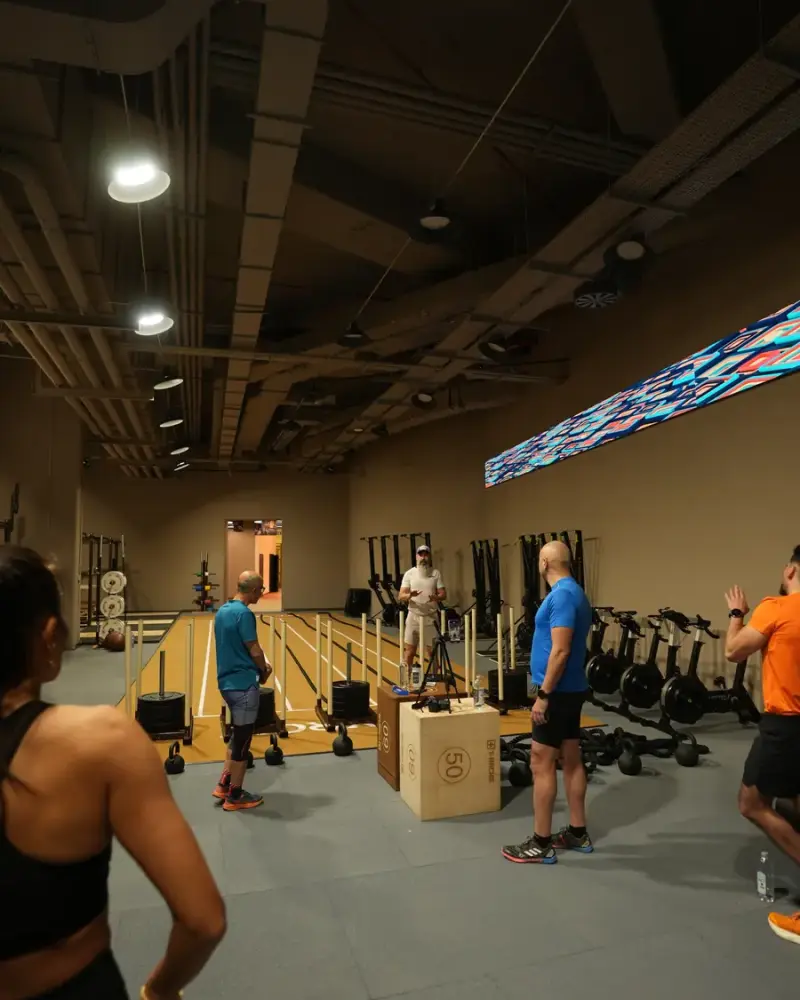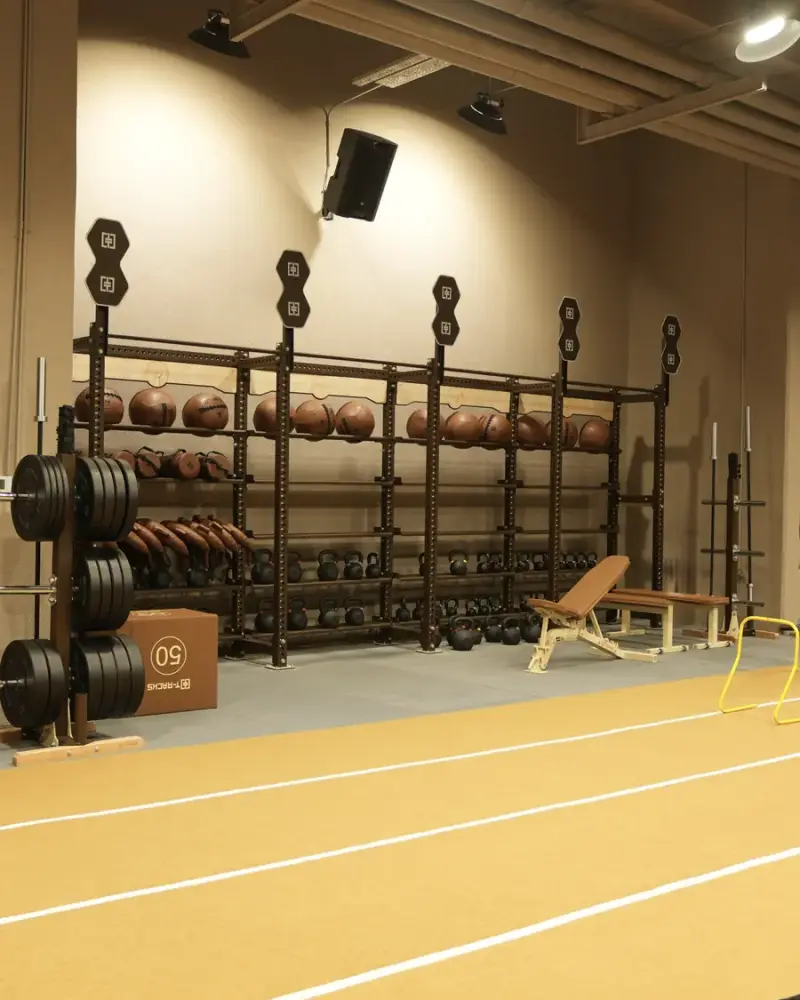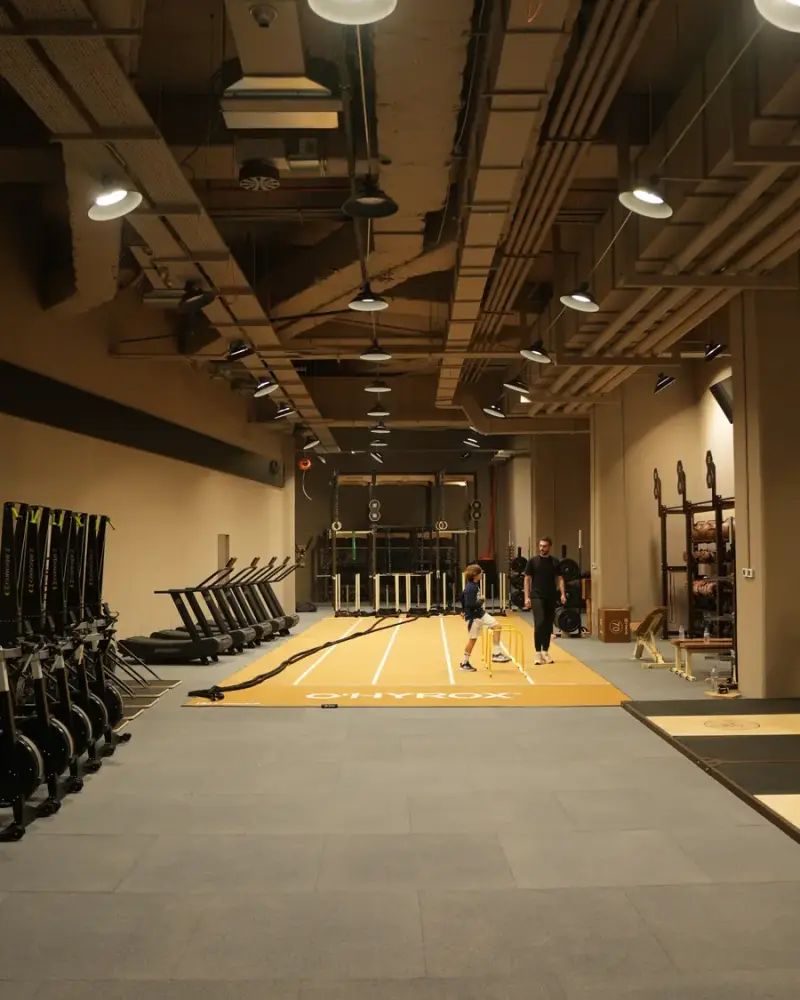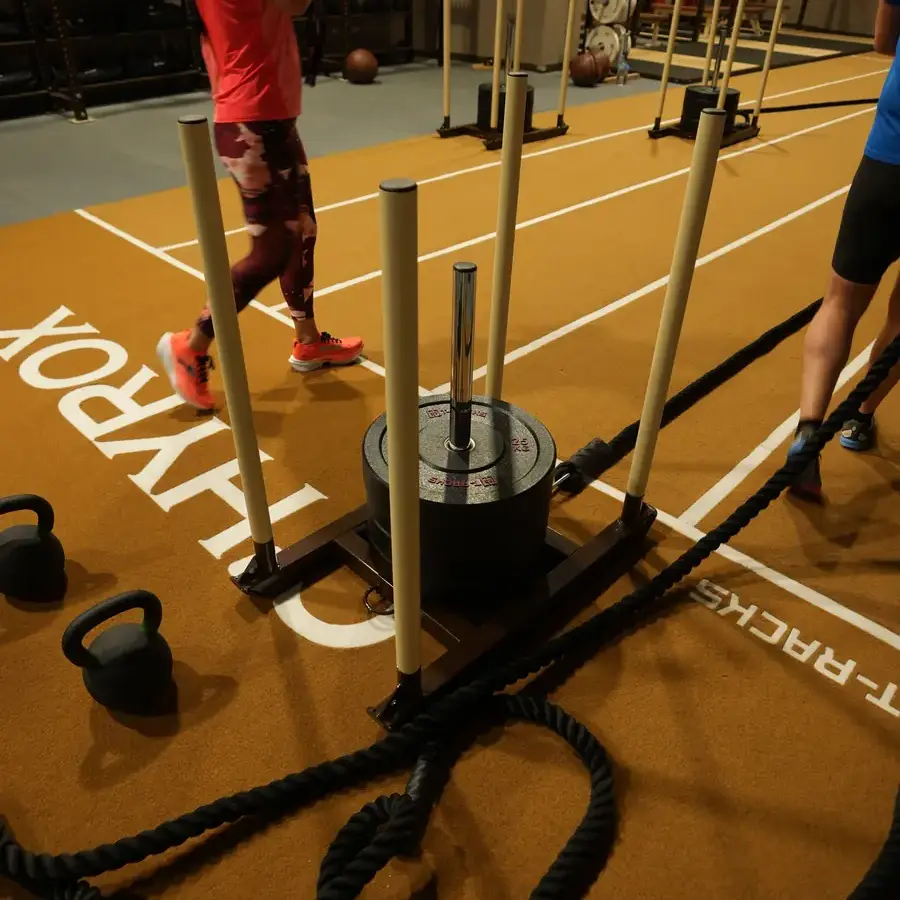
Your first HYROX session will most likely last 60-75 minutes, start with a level assessment and not force you to do the whole race in one session. The standard flow is: a short consultation, a 10-12 minute warm-up, technique coaching on two or three stations, a short hybrid block and a cool-down. You won't try all eight race stations on day one; the goal is to learn the movements correctly and put your current level into numbers.
Why isn't the first session a “full race rehearsal”?
The most common expectation among new athletes is to try all eight stations from start to finish on day one. There are three reasons we don't do this. First, technique learning doesn't hold up under fatigue; a faulty pattern learned while tired persists for weeks. Second, stations like Sandbag Lunges and Sled Push heavily load muscle groups you aren't used to; doing them at full dose on day one means a week of soreness and missed sessions. Third, an assessment taken while fatigued is useless; you'd be building the next 12 weeks of planning on the wrong numbers.
Instead, the first session has three goals: finding the load range that suits you, establishing the standard for the three most critical movements, and introducing the race rhythm in a small dose. Full rehearsals are done in the middle and at the end of preparation; by then you'll already know the format.
Before the session: what to bring, what to eat?
The list of what to bring is short: a supportive but not overly soft athletic shoe, a sweat-wicking T-shirt, knee-length or above-the-knee shorts or tights, at least 750 milliliters of water, a towel, and thin gloves or none at all. Tights are more comfortable than long shorts for sandbag and sled work because they reduce friction on the shoulders and legs.
Two small apparel details become clear in the first session: long socks protect the calves during sandbag lunges, and for someone starting to develop calluses on their palms, thin gloves add comfort during the Farmers Carry and Sled Pull. Using powder or chalk isn't required.
On the food side, a simple rule works: a normal carbohydrate-heavy meal 2-3 hours before the session, and a small piece of fruit 45-60 minutes before if needed. Coming on an empty stomach raises the risk of dizziness in the first session; coming on a full stomach causes stomach discomfort during wall balls and burpees. If you use caffeine, the smartest move is not to exceed your usual dose.
The session minute by minute
A new athlete's first 70-minute session is typically divided into the following parts. This table clears up most of the uncertainty in your mind.
| Minute | Part | What's done |
|---|---|---|
| 0-5 | Consultation | Goals, training history, injury history, weekly availability |
| 5-10 | Movement screen | Squat depth, ankle and shoulder mobility, single-leg balance |
| 10-22 | Warm-up | Ergometer, dynamic mobility, light bodyweight work |
| 22-45 | Technique | Usually coaching on two or three stations, reps at low load |
| 45-58 | Hybrid block | A combination of running and stations in short rounds |
| 58-70 | Cool-down and plan | Bringing heart rate down, stretching, discussing the weekly plan |
First 15 minutes: assessment and warm-up
The coach doesn't put you straight under a heavy load. First comes a movement screen: can you get into a deep squat, how much does your ankle flex, is your shoulder comfortable overhead, how's your balance on one leg? The screen takes five minutes but shapes the next 12 weeks of programming. If your ankle is restricted, Sled Push technique is taught differently; if your shoulder is restricted, wall ball depth and the SkiErg grip are adjusted.
Then comes a 10-12 minute warm-up. A typical flow: 3-4 minutes of light rowing or SkiErg, dynamic mobility (hip openers, leg swings, shoulder circles), 2 rounds of 10 air squats, 8 reverse lunges, 6 slow burpees and a 20-second dead hang. The goal of the warm-up isn't to get tired but to raise your heart rate to around 120-130 and get your joints ready. The full routine we use is laid out step by step in the 12-minute warm-up protocol article.
The technique block: which stations are taught on day one?
Cramming eight stations into one session hurts learning. For most new athletes, the day-one selection is the following three, because they're the ones where technique errors cost the most:
- Wall ball (10-15 reps × 2-3 sets): Depth, ball contact height and breathing rhythm are worked on. There are 100 reps in the race; the logic of a rep-breaking scheme is explained from day one.
- Sled push (2-3 × 12.5 meters, light load): Torso angle, arm position and short-step technique. The load is deliberately kept light; the goal is to feel the right position.
- Sandbag lunges (2 × 20 meters): Knee direction, trunk stability and stride length while carrying a load on the shoulders. The distance is shortened for those with knee pain.
In the second or third session, the SkiErg, rowing, Farmers Carry, Sled Pull and Burpee Broad Jump come in. The 8 stations guide is the reference text for the detailed technique of each movement; reading it before the session speeds up learning.
The first hybrid block: what does it feel like?
After technique comes a short work block. A reasonable example for a beginner: 3 rounds of 400 meters running, 10 wall balls, 20 meters of Farmers Carry, with 60-90 seconds of rest between rounds. It takes 12-15 minutes in total and raises your heart rate significantly.
What you'll notice here is that the individual movements are easy but the sequence creates fatigue. A 400-meter run on its own isn't hard; running right after wall balls is different. This feeling is called compromised running and it's at the heart of HYROX preparation. In the first session, recognizing it is enough; you don't need to master it.
Your heart rate climbing into the 170s and your breathing speeding up is normal. What's abnormal is chest pain, dizziness, tunnel vision or nausea; in that case, the right thing is to stop the session and see a physician if the complaint persists. Asking the coach to lower the intensity isn't weakness; it's producing accurate data.
What do you walk away with at the end of the session?
A good first session leaves you informed, not exhausted. You should walk away with the following data:
| Measurement | Why it matters | Typical first-session value |
|---|---|---|
| 1 km run time (rested) | The basis for pace calculation | A range of 4:45-6:30 for women and 4:15-6:00 for men is common |
| Number of unbroken wall balls | Determines your rep-breaking scheme | 15-35 reps |
| Farmers carry grip time | Grip endurance | 40-90 seconds |
| Air squat depth | Wall ball and lunge quality | Full depth or a note on restriction |
| Ankle range of motion | Sled Push efficiency | Free or restricted |
These numbers are enough to write the plan for the next 4 weeks. If you want to assess yourself, you can follow the protocol in the level test article.
How sore will you be in the first week, and what should you do?
Sandbag Lunges and Sled Push load muscle groups you aren't used to; expect tightness in the front of the thighs and the glutes within 24-48 hours. This is called delayed onset muscle soreness and is normal in the first two weeks. Managing it is simple: instead of stopping completely the next day, 20-30 minutes of walking or light cycling, enough protein, enough sleep. For detailed management, our DOMS article for more.
A practical schedule for the first week: two HYROX sessions with at least one day off in between. Waiting for your body's response to settle before adding a third session gives better results. Adding the third session only once the soreness has fully passed leads to faster progress.
Should you start with group sessions or one-on-one?
Both work; the choice depends on your goal and learning speed. Group sessions are more efficient when you need pace set from the outside and you draw motivation from the community; they also introduce the crowded feel of the race environment early. One-on-one work offers a safer start for the first three or four sessions if you have a restriction, for example limited ankle range of motion or a history of back problems.
In practice, the route we use most often is a hybrid setup: the first two sessions one-on-one, then two group sessions a week and a technique check every four weeks. This setup both prevents technique errors from becoming ingrained and builds the habit of weekly consistency with community support. To compare which session type suits you, the classes page for more.
Whatever you decide, the goal of the first four weeks is the same: learn the movements correctly, don't miss two or three sessions a week, and increase running volume gradually. Increasing load before technique and consistency are in place is the most common cause of injuries in the first month.
Newcomers' three most common worries
“I'll be the slowest one.” In group sessions, pace is set by individual threshold; in the same block one person runs 400 meters in 1:30 and another in 2:20, and both have done the right work. Nobody waits on anybody's time.
“I don't know the movements; I'll be embarrassed.” None of the stations require gymnastics or Olympic lifting skills. The basic wall ball standard settles in one session; the rest is repetition and fatigue management.
“Do I have to go to a race?” No. A significant share of athletes train with this program without ever registering for a race, because the format measurably changes conditioning, strength and body composition on its own. If you like, you can track your own time in in-club simulations.
At Hybrid Sky, the first session is built on this logic: measure, teach, apply in a small dose. To see what we work on which day, the weekly schedule is worth a look, and to see which session type suits you, on the classes page for more.
How long does a first HYROX training session last?
Usually 60-75 minutes. About 15 minutes of that is assessment and warm-up, 25-30 minutes technique coaching, 12-15 minutes a short work block and the rest cool-down.
Can I join a first session if I've never exercised?
You can. Loads and distances are scaled to your level; the goal of the first session isn't to get tired but to learn the movements and take measurements.
Will I do all eight stations in my first session?
No. Usually two or three stations are taught. Trying all of them hurts technique learning and causes unnecessary soreness.
What should I do if I'm very sore the next day?
Light walking, enough protein and sleep help the soreness pass faster. If the pain is sharp, in one spot and lasts longer than a week, see a physician.
A stronger version of you.
Just one step away.
24 hours from your first message to your first session. Let's build your program together — reach out on whichever channel suits you.
Weekdays 06:00 - 23:00