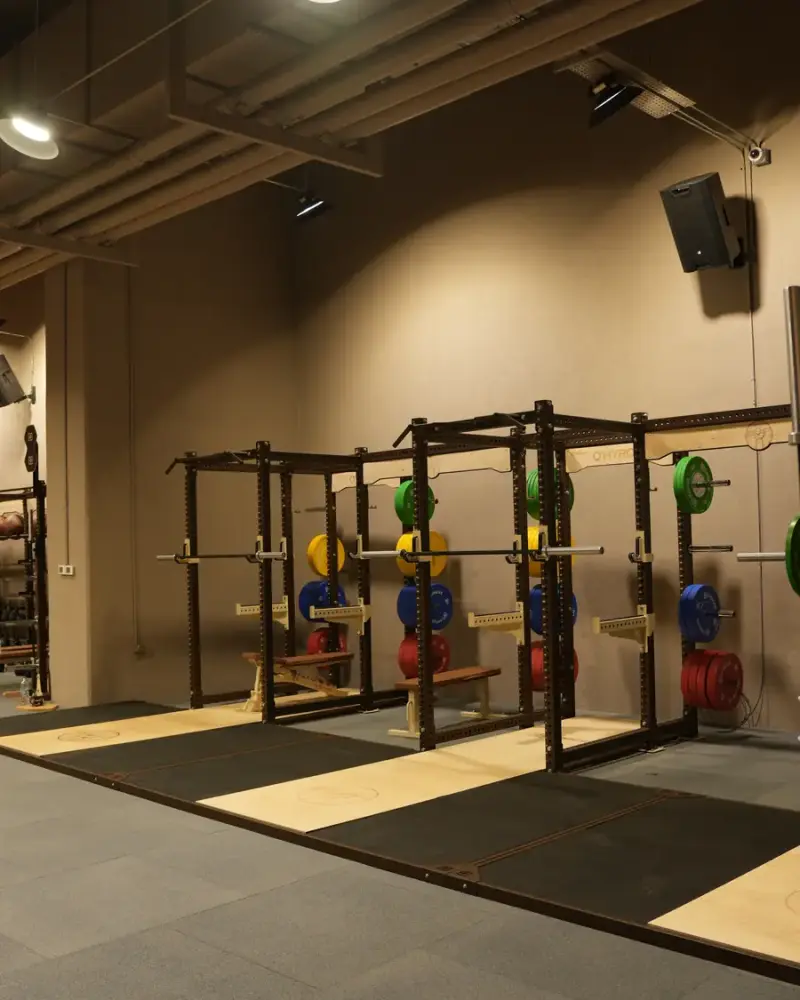
12 weeks is a sufficient and comfortable timeframe for someone with a regular training background to prepare for their first HYROX. The plan consists of three four-week blocks: a base block (aerobic capacity and strength), a specificity block (stations and fatigued running), and a race block (race pace and taper). It assumes four training days a week; ways to adapt it to three or five days are covered below. The goal isn't to do the hardest program possible, but to build a loading curve you can sustain without interruption for 12 weeks.
The program's logic: three blocks, three different questions
Each block seeks to answer a different question. Mixing the blocks turns 12 weeks into 12 separate weeks, and adaptation doesn't accumulate.
| Block | Week | The question it asks | Dominant work |
|---|---|---|---|
| 1 — Base | 1-4 | Can I handle the 8 km of running and the race loads? | Zone 2 running, heavy strength, technique learning |
| 2 — Specificity | 5-8 | Can I run coming off a station? | Compromised running, station volume, threshold running |
| 3 — Race | 9-12 | Can I hold my target time? | Race pace, rehearsal, taper |
The fourth week of each block is a pull-back week: volume drops by about 40 percent while intensity is maintained. We covered the role of these weeks in detail in our deload week article. For the theoretical basis of how to transition between blocks, see the periodization article.
Before you start: level test and target time
Before writing the program, you need two numbers: your current 5 km run time and your time to complete each station at race load. Do the following test within the first week:
- 5 km time trial. After a warm-up, on flat ground if possible. This number will be the reference for your running paces.
- Individual station test (spread over two days). Time 1000 m SkiErg, 1000 m Row, 50 m sled push, and 100 wall balls separately.
- Strength reference. Note the load you can lift for 5 reps on the back squat and deadlift.
Your target time comes from these three data points. The detailed version of the test HYROX level test in the article, and the split calculation method setting a target time article.
Block 1: Base (weeks 1-4)
The goal of this block is to safely build running volume and lay the strength foundation. Stations are worked here in technique-learning mode, not under fatigue.
| Day | Session | Weeks 1-3 content |
|---|---|---|
| Monday | Strength A | Back squat 4×6, Bulgarian split squat 3×10, wall ball 4×20, core block |
| Tuesday | Zone 2 run | 45-60 min easy pace, conversational intensity |
| Thursday | Strength B | Deadlift 4×5, single-arm row 4×10, farmers carry 4×100 m, sled push 6×20 m |
| Saturday | Station technique + run | SkiErg 4×500 m, Row 4×500 m, 30 burpee broad jumps + 3 km easy run |
In Week 4, volume drops: strength sets go down to 3, the zone 2 run is cut to 35 minutes, and the station session is halved. Adjust how fast you increase running volume according to the thresholds in the weekly running volume article; to learn what zone 2 is and how to find it, see Zone 2 training article.
Block 2: Specificity (weeks 5-8)
Here the program changes character. Strength volume drops somewhat, while station and compromised running volume rises markedly. On the running side, part of the zone 2 work turns into threshold running.
| Day | Session | Weeks 5-7 content |
|---|---|---|
| Monday | Strength A (moderate load) | Front squat 4×5, sandbag lunge 4×25 m, wall ball 5×25 |
| Tuesday | Threshold run | 3×8 min at threshold pace with 2 min walks between; or 6×800 m |
| Thursday | Strength B + sled | Romanian deadlift 4×8, sled push 8×20 m, sled pull 6×25 m, grip block |
| Saturday | Compromised running | 5 rounds: 15 wall balls + 400 m run + 15 wall balls, 90 sec between rounds |
Do a half simulation in Week 6 or 7. Week 8 is a pull-back week, and no compromised sessions are done that week. For how fatigued running skill is developed, see the compromised running article; for rehearsal formats, see the HYROX simulation article.
Block 3: Race (weeks 9-12)
In the final block, the goal isn't to gain new capacity but to make what you've gained usable at race pace. Week 9 has a full simulation, weeks 10-11 have race-pace repeats, and Week 12 is the taper.
| Week | Focus | Main session |
|---|---|---|
| 9 | Validation | Full simulation (8 km + 8 stations, timed) |
| 10 | Recovery + tempo | Light early in the week; Saturday 4×(1 km at race pace + 1 station) |
| 11 | Race pace | Second-half rehearsal, at race loads, with target splits |
| 12 | Taper | Volume drops 50%, intensity kept short, last 3 days very light |
For a day-by-day breakdown of the final 10 days, see the HYROX taper article; for the race-day flow, see the race day guide.
Adapting to 3 or 5 days a week
The program is built on four days, but it's flexible.
- 3 days: Combine Strength A and B into one session (one movement from each pattern), keep the quality run, and keep the Saturday hybrid session. The block logic stays the same; progress slows somewhat.
- 5 days: Add a 40-50 minute zone 2 run or row on Wednesday. It's critical that the extra day isn't high intensity.
- 6 days: 30-40 minutes of active recovery on Sunday (walking, swimming, mobility). Don't add a new loading day.
To decide how many days are right for you, use the how many days a week should you train article, and to rewrite the template yourself, use the programming article.
What to track over 12 weeks? Five metrics
To know the program is working, note five numbers every week. If these numbers plateau, the program should change.
- Total weekly running distance. Increases in Block 1, decreases in Block 3.
- Speed run at the same heart rate at zone 2 pace. The cleanest indicator of aerobic development.
- 100 wall ball time and number of breaks. Measure every 3-4 weeks.
- The difference between a fatigued 1 km and a fresh 1 km. The success measure for Block 2.
- Morning resting heart rate and sleep duration. The first signs of overload show up here.
If the values in the fifth item stay off for weeks, you need to pull volume back; we listed the symptoms in the overtraining syndrome article. For a logging format, the training log article makes the job easier.
Spreading nutrition and recovery across 12 weeks
No matter how well the training plan is written, if the recovery side is empty you won't finish the 12 weeks. Three items should be planned alongside the program:
Carbohydrate timing. In Block 1, daily carbohydrate needs are relatively low; in Blocks 2 and 3, compromised sessions and race-pace repeats deplete muscle glycogen significantly. Taking in carbohydrates 2-3 hours before and right after a hard session directly affects the quality of the next day. We've collected the details in the nutrition guide.
Sleep. Cutting sleep during weeks 5-7, when program volume rises, is the most common reason progress stalls. Most athletes aim for 7-9 hours a night; we covered the link between sleep and performance in the sleep and performance article.
Active recovery. Rest days in the program don't have to be completely inactive. A 20-30 minute walk, an easy row, or a swim usually does a better job of reducing muscle soreness than passive rest. How to set one up is explained in the active recovery day article.
A special note for athletes with weight goals: going into a calorie deficit in the last 4 weeks of a 12-week preparation lowers performance. Body composition goals belong in Blocks 1 and 2; Block 3 is performance-focused.
Three common mistakes
Skipping Block 1. The most common mistake is jumping into compromised running from the first week out of excitement. Fatigued running sessions done before an aerobic base is built produce fatigue, not progress.
Ignoring pull-back weeks. Skipping a deload week because you feel good usually comes back as a performance drop around weeks 8-9.
Taking every session to the max. Turning zone 2 runs into tempo runs breaks the backbone of the program. Easy days are easy so that hard days can be hard.
At Hybrid Sky, this 12-week skeleton is adapted to each athlete's test results; because the running track and station area sit side by side, compromised sessions can be set up close to race conditions. The weekly flow in the class schedule, the facility layout on the concept page for more.
Is 12 weeks enough for a first HYROX?
It's enough for someone who trains regularly. Someone with no training background should go through a 6-8 week general conditioning phase before this program.
How many weeks before the race should I start the program?
Count back 12 weeks from the race date. Week 12 is race week, meaning the last day of the program is race day.
Can I extend one of the blocks?
Yes. If you have 14-16 weeks, extending the base block to 6 weeks is the safest extension. Keeping the race block longer than 4 weeks usually brings no benefit.
What should I do if I get sick or miss a week?
Don't try to cram the missed week; repeat the last week of the block you're in and carry on. With a feverish illness, wait for symptoms to clear before returning to training, and see a doctor if they persist.
A stronger version of you.
Just one step away.
24 hours from your first message to your first session. Let's build your program together — reach out on whichever channel suits you.
Weekdays 06:00 - 23:00