For someone living in Kağıthane or Seyrantepe who wants to prepare for HYROX, the most practical program is built around coming to Sky three days a week and filling the days in between with easy aerobic work in the neighborhood. These two neighborhoods sit on the more central side of the city relative to Hybrid Sky in Sarıyer, which means the gym may be on a route you can stop at on your way to work in the morning or home in the evening. This article shows how to use that route efficiently and offers an 8-week program framework.
Planning training from Kağıthane and Seyrantepe
Kağıthane is a district with a large young population that has changed rapidly in recent years with residential and office projects. Seyrantepe is an area near the Sarıyer border, home to large residential complexes and the area around the stadium. What residents of both neighborhoods have in common is commuting to the business centers in the north of the European Side. This commute determines where training fits in.
In this article, we don't give travel times or transit line numbers, because these vary a lot depending on the time and your preferred mode of transport. Use a map app for route planning; if you have transportation questions, our contact page write to us. Our focus is how you build your week, whichever route you take.
Before you start planning, ask yourself three questions. Is getting to Sky on my commute route, or a separate trip? Which evenings of the week are freer? How much time can I set aside for training on the weekend? The answers determine which version of the template below you'll use. Writing the answers down may seem trivial, but a plan noted on paper gets carried out far more often than an intention kept in your head. Treat the first two weeks as a trial period: track how many of your three planned gym days you actually complete and which days keep slipping, then adjust the structure accordingly.
Three days at the gym, two in the neighborhood: the hybrid week logic
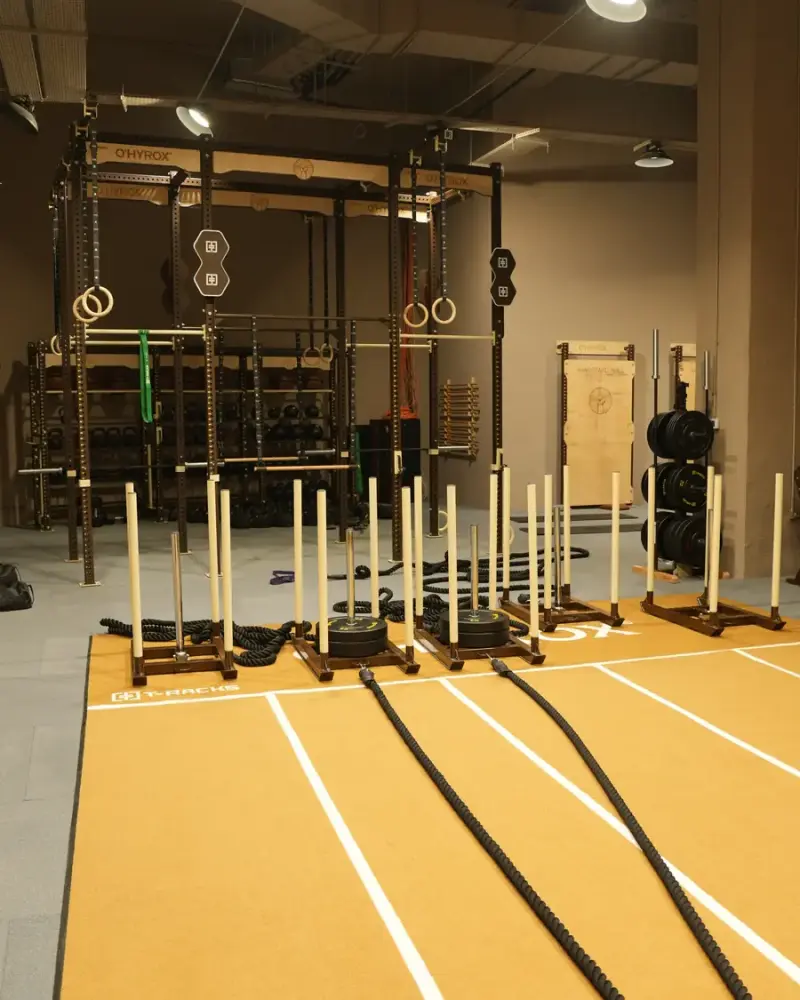
For someone coming from Kağıthane or Seyrantepe, coming to Sky every day may not be realistic. But HYROX preparation doesn't require being at the gym every day. The work that absolutely requires the gym is Sled Push, Sled Pull, SkiErg, rowing, Wall Balls, and heavy strength work. Easy running, mobility, and bodyweight circuits can be done in the neighborhood.
| Type of work | Where? | Why? |
|---|---|---|
| Sled Push / Pull | Sky | Requires specialized equipment and a suitable surface |
| SkiErg, row | Sky | Requires an ergometer; race-specific pace is trained |
| Wall Balls, Sandbag Lunges | Sky | Standard ball and target height, proper sandbag |
| Heavy strength (squat, deadlift) | Sky | Safe loading and technique supervision |
| Easy running (Zone 2) | Neighborhood | No equipment needed, saves time |
| Mobility and core | Home | 15-20 min, minimal equipment |
| Long run | Open space | Weekend, experience on different surfaces |
This split lets you devote your three days at Sky to the most valuable work. Making a long trip just to do an easy run on a gym treadmill is inefficient. For the differences between treadmill and outdoor running, see in the treadmill vs outdoors we compared in our article.
8-week program framework
The framework below is designed for someone who exercises regularly but is preparing for HYROX for the first time. Gym days are assumed to be Tuesday, Thursday, and Saturday; you can shift them to fit your schedule, as long as there's at least one day between two hard gym days.
- Weeks 1-2 (Base): Tuesday strength + sled technique; Thursday erg intervals (row and SkiErg, 6×3 min); Saturday station familiarization circuit. In the neighborhood, 30 min easy runs on Monday and Wednesday.
- Weeks 3-4 (Volume): Strength sets increase; Thursday intervals rise to 5×5 min; Saturday 4 rounds of run + station (half volume). Neighborhood runs 35-40 min.
- Week 5 (Deload): Total volume is cut by about a third. Technique and mobility take priority. Skipping this week lowers your performance in week 6.
- Weeks 6-7 (Specificity): Saturday half HYROX simulation; Thursday compromised running (800 m run + station, 4 rounds). A tempo run is added on one neighborhood day.
- Week 8 (Test): Light midweek, Saturday in-club simulation or full rehearsal. The results become the starting data for the next block.
You can find the logic of the deload week in our deload week article, and how to set up a simulation in our HYROX simulation guide.
Easy running in the neighborhood: safety and surface tips
Kağıthane and Seyrantepe are densely built-up areas; finding ideal flat, uninterrupted space for running isn't always easy. So instead of recommending a specific route, we share the principles to keep in mind when choosing your own.
- Choose well-lit roads away from traffic. If you run in the evening, well-lit routes with pedestrian traffic are safer. Wearing something reflective improves visibility.
- Factor in the hills. Sloped streets are common in these neighborhoods. On easy run days, slow down on hills and walk if needed; the goal is to keep your heart rate low.
- Sidewalks and surface. Broken sidewalks increase the risk of ankle sprains. Getting to know your route on foot first is a good habit.
- Mind the air quality. It makes sense to stay away from main roads during rush hour. We touched on this in our article on air pollution and outdoor training.
- Spaces inside residential complexes. The internal walking paths of the large residential complexes in Seyrantepe can be used for short loop runs; don't forget to follow the complex rules.
Making the most of your days at Sky
If you're making a dedicated trip to Sky, every minute of that session counts. A few practical tips:
Start your warm-up on the way
If you're coming from a point where you can walk to the gym, do the last few minutes as a brisk walk. By the time you walk in, you'll have already completed the first stage of your warm-up.
Know the session in advance
Decide which stations and loads you'll work on the evening before, not on the way. If you're joining a group class, knowing the program in advance makes mental preparation easier. Our class schedule helps with this planning.
Two goals in one session
To lower the cost of the trip, you can make your gym sessions a bit longer with two focuses: strength first, followed by a short station block. But with this approach, don't stack two hard efforts back to back; for information on the interference effect, see strength and cardio on the same day article.
Sample gym day: Thursday compromised running session
The Thursday session in weeks six and seven of the program is the most critical gym day of the week for someone coming from Kağıthane or Seyrantepe. This session mimics the hardest moment of the race: leaving a station and getting back to running on tired legs. The session can flow like this:
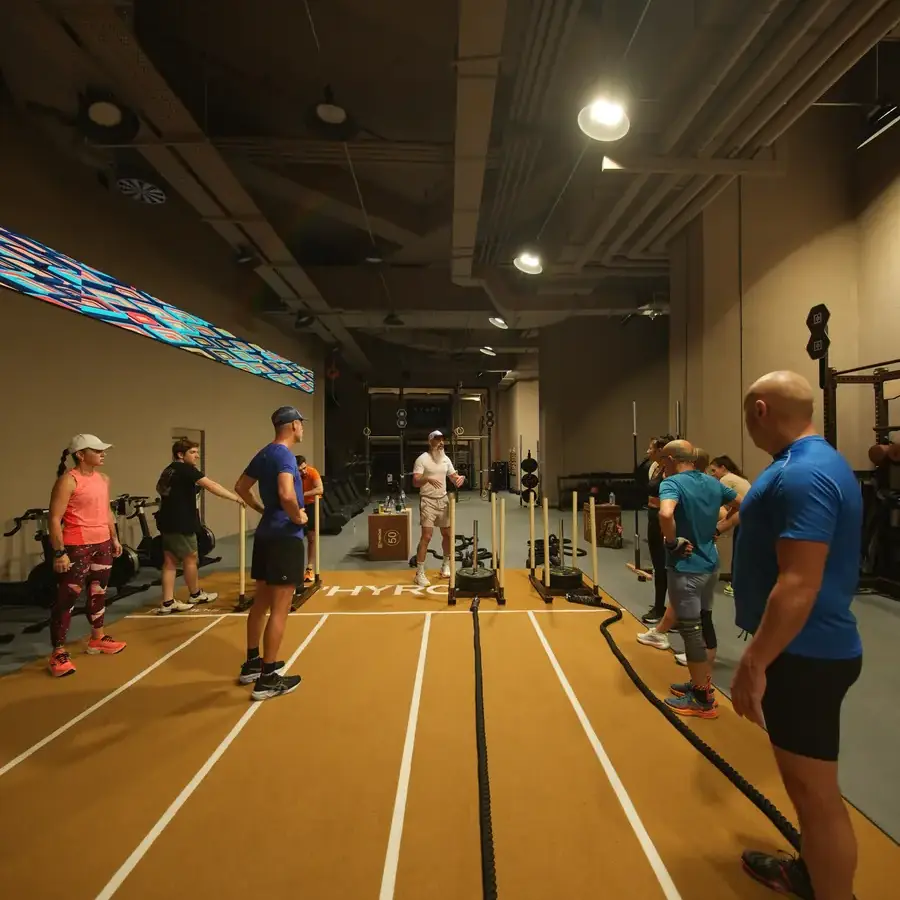
First, a 10-minute progressive warm-up: 4 minutes of easy rowing, then hip and ankle mobility, then two short strides. The main block is four rounds. Each round is an 800 m run followed by, in order, 500 m SkiErg, 20 m Sled Push, 30 Wall Balls, and 40 m Sandbag Lunges. 90 seconds of walking between rounds. The goal is to keep your 800 m time similar across rounds; running the first round fast and collapsing in the last is a sign you'll make the same mistake in the race.
At the end of the session, cool down with 5 minutes of easy pedaling or walking and a short stretch. Note your round times; when you repeat the same session two weeks later, your consistency should have improved. You can find general pacing principles in our pacing strategy article. Because these sessions create high fatigue, the next day must be an easy or rest day.
Recovery on the way home in the evening
The trip home after an evening session is also part of recovery. Prepare a small source of protein and carbohydrates for after the session so you don't go hungry on a long ride home. When you get home, a balanced meal rather than a heavy one protects your sleep quality.
Sitting for a long time on the way home, especially after sled- and lunge-heavy sessions, can make your legs feel stiff. Five minutes of light stretching and walking when you get home reduces this feeling. Protecting your sleep schedule is as important a part of this program as the training itself, because three hard gym sessions a week are only sustainable with good recovery.
Common practical questions for people coming from Kağıthane and Seyrantepe
Should you join group classes or personal training? This decision depends on budget, programming needs, and your source of motivation. Group classes provide social motivation and structure, while personal training focuses on technical detail and individual planning. For someone coming three days a week, a good balance is often two group classes and a few personal technique sessions a month. Write to us for current class options and terms.
If your race goal isn't clear yet, don't rush. First build your routine over four to eight weeks, then pick a race date. Once the routine is in place, this route from Kağıthane or Seyrantepe to Sky becomes a natural part of your daily rhythm rather than a burden. Get in touch to structure your program together.
Is coming to the gym three days a week enough for HYROX?
Yes, if the other days are supported by easy running in the neighborhood and mobility at home. It's important to dedicate gym days to equipment-dependent work like sleds, ergs, Wall Balls, and heavy strength.
Where should I do my easy runs?
Choose a well-lit route away from traffic with good footing. Slow down on hills and get to know the route on foot first.
Which route should I take to get to Sky?
Since the route changes depending on the time and your preference, we recommend using a map app. For other questions, write to us through our contact page.
What should I do at the end of the 8-week program?
Measure your results with a simulation and use them as the starting data for the next block.
A stronger version of you.
Just one step away.
24 hours from your first message to your first session. Let's build your program together — reach out on whichever channel suits you.
Weekdays 06:00 - 23:00