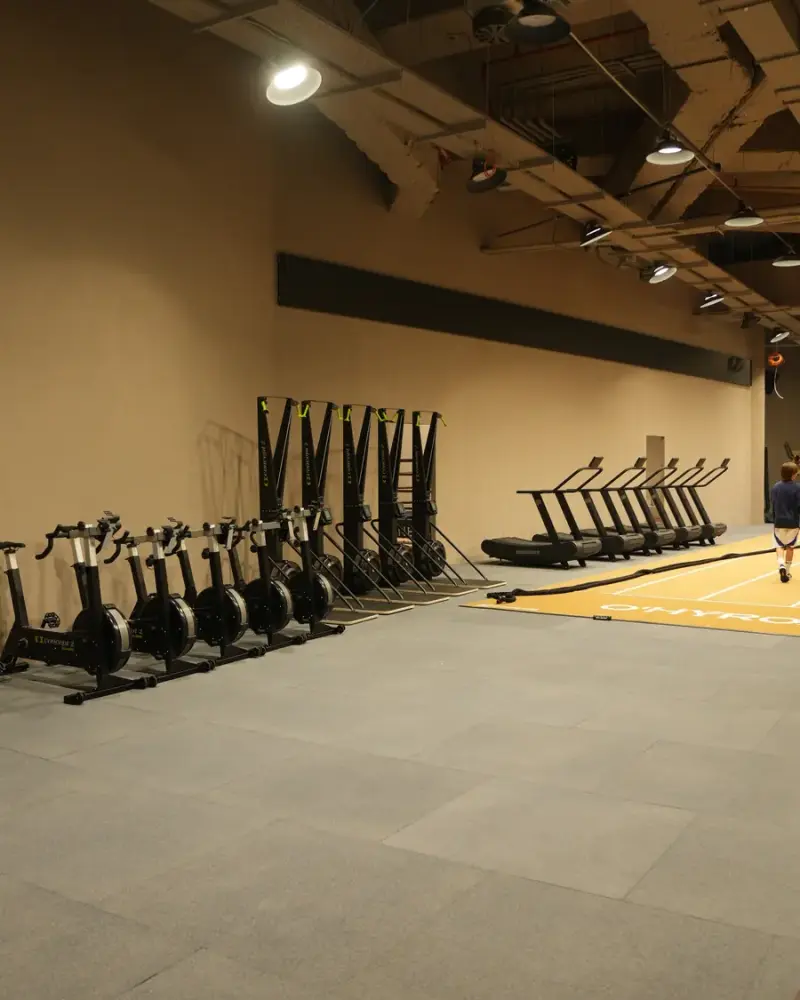
Cycling clearly contributes to HYROX preparation, but it doesn't replace running. Its contribution comes down to three things: building aerobic capacity without impact load, developing strength endurance in the hip and thigh muscles, and providing a low-cost form of movement that increases blood flow on recovery days. Its limit is equally clear: cycling doesn't prepare your calves, Achilles tendon and soles of your feet for the impact of running, and it doesn't improve running economy. So the practical approach is to use the bike as a complement to running, not a substitute.
What does cycling concretely contribute to HYROX?
The first contribution is your cardiovascular base. Aerobic development largely depends on how the heart and the energy systems within the muscle respond to a stimulus, and the means of delivering that stimulus is relatively flexible. Pedaling for 60 minutes in the same heart rate zone produces a central adaptation close to 60 minutes of easy running. That's why, for an athlete who can't increase weekly running volume, cycling is the safest way to build aerobic volume.
The second contribution targets the glutes and quads. Climbing work at high resistance and low cadence gets these muscles used to sustained contraction. In HYROX, the sled push and sandbag lunges demand exactly this capacity. Cycling doesn't replace these stations, but it feeds the strength endurance underlying them.
The third contribution is recovery. 25-35 minutes of easy pedaling the day after a hard simulation session increases blood flow without straining the muscles and, for most athletes, brings back the desire to move. We covered the framework for this approach in our article on active recovery.
What doesn't it cover? Three clear limits
The most obvious limit of cycling is mechanical specificity. In running, your foot strikes the ground, muscles contract while lengthening and tendons store elastic energy. On the bike there's no such cycle; pedaling is almost entirely based on shortening contractions. That's why an athlete who has only cycled for weeks finds, on returning to running, that their breathing is fine but their calves and the sides of their hips get surprisingly tired.
The second limit is how muscle groups are used. Cycling predominantly loads the quads and uses the hamstrings and glutes less than running does. Over time, this imbalance can affect running form; so it's reasonable for athletes increasing cycling volume to do separate work for the posterior chain.
The third limit is economy. The ability to use less energy at the same speed develops through repetition of the running movement. That's why an athlete who wants to improve race pace gets results by improving running quality, not by increasing cycling volume; we explained the mechanism in our running economy article in more detail.
Who benefits most from cycling?
| Profile | Weekly cycling | Goal |
|---|---|---|
| Higher body weight | 2-3 sessions, 40-60 min | Aerobic volume without impact load |
| Recurring calf/Achilles complaints | 2 sessions, 45 min | Limiting running volume |
| Office worker with limited weekday time | Commuting to work | Passive volume gain |
| Athlete with a strong running background | 1 session, 30-45 min | Recovery and variety |
| Injury period | 3-4 sessions | Maintaining fitness |
The row that stands out in the table is the third one. For someone in Istanbul with a suitable route, cycling to work adds 2-4 hours of low-intensity aerobic volume without adding extra sessions to the week. It's outside the program but a real gain; we discussed how to deal with traffic and time pressure in a separate article.
Four cycling protocols
- Base session. 45-75 minutes, cadence 85-95, heart rate in the aerobic zone. An intensity at which you can hold a conversation. The cheapest way to build weekly aerobic volume.
- Climbing strength. 6-8 × 3 minutes at high resistance, cadence 55-65, seated. 2 minutes easy between. Targets strength endurance in the glutes and quads.
- VO2 intervals. 5-6 × 3 minutes hard, with 3 minutes easy in between. A high-intensity aerobic stimulus at a much lower mechanical cost than running. The protocol logic in our VO2 max article too.
- Recovery spin. 20-35 minutes at very low resistance, cadence 85-95, low heart rate. Done the day after a hard session.
The second and third of these protocols draw from your high-intensity budget. So if you plan two hard sessions a week, one can be on the bike, but it isn't added on top of your running intervals.
Bike or ergometer?
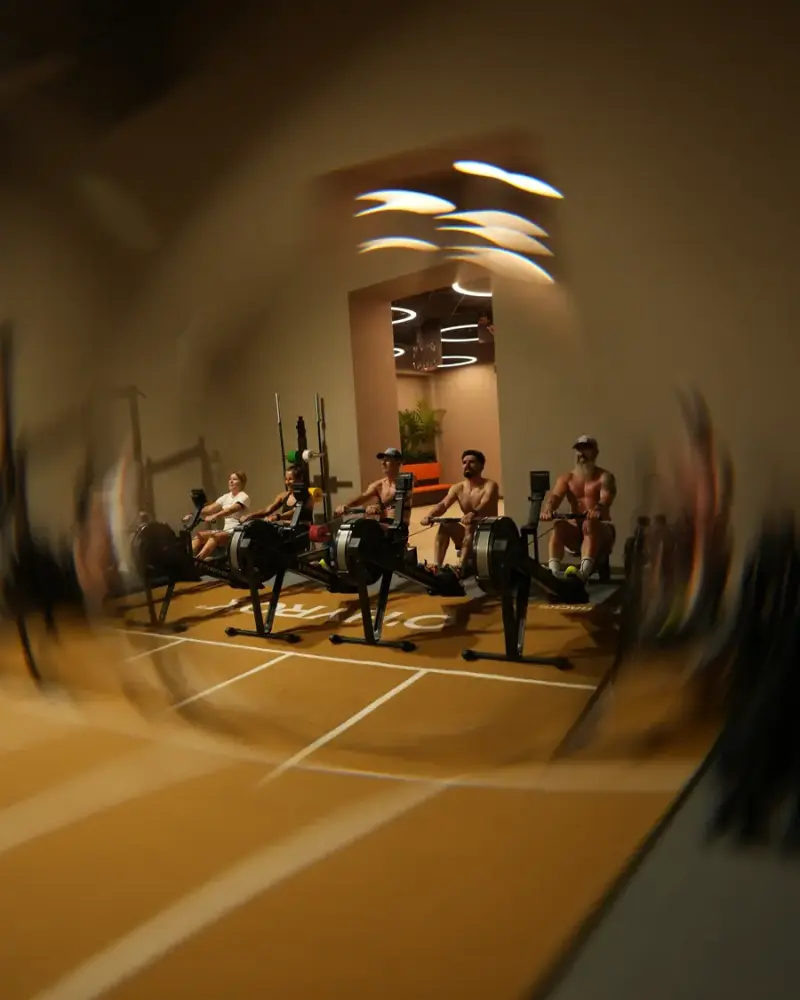
Both are low-impact aerobic tools, but they do different jobs. The rower and SkiErg also load the upper body and core, and they're already part of HYROX as two stations; in other words, they're directly race-specific. The bike focuses only on the legs and has no equivalent in the race, but it's more comfortable for long low-intensity volume; doing a 90-minute base session on the bike is much easier than on the rower.
The practical recommendation: if you're after race-specific gains, prioritize the ergometer; if you're after raw aerobic volume, the bike. You can find the details of this comparison in our article on ergometer alternatives . You don't have to keep all three in your weekly program; two tools are enough for most athletes.
What data should you look at in a cycling session?
There are three ways to measure intensity on the bike, and each serves a different function. Cadence, the number of pedal revolutions per minute, determines the mechanical character of the movement: 85-95 rpm is an aerobic, joint-friendly range, while 55-65 rpm produces a strength-focused stimulus. Heart rateis an indicator of central load, but on the bike it runs roughly 5-10 beats lower than when running; so carrying the heart rate zones you set for running directly over to the bike is misleading.
Power is the most reliable data if you have it, because it isn't affected by fatigue or heat. On a stationary bike with a power meter, repeating the same protocol at the same wattage over several weeks and watching your heart rate drop is the clearest way to see aerobic progress. If you don't have a measuring device, a perceived exertion scale is a practical alternative; we explained how to use it in our RPE article in more detail.
The minimum dataset to log is short: duration, average cadence, perceived exertion and, if available, average heart rate. These four lines are enough to see where bike sessions fit into your weekly load. On choosing a heart rate monitor, we explained that a chest strap is more consistent than wrist-based measurement in the related article too.
When does cycling volume do harm?
Cycling seems harmless because there's no impact load, but that doesn't mean it doesn't produce fatigue. Cycling volume above 5-6 hours a week lowers the quality of your strength sessions and never leaves your legs fresh. In HYROX, the sled and lunge stations are developed with fresh legs; a strength session done on constantly tired legs doesn't build strength.
The second risk is your time budget. Because cycling is enjoyable, it easily moves to the center of your program and pushes running out. Yet half the race is running, and running volume dropping below a certain threshold isn't a gap the bike can close. We laid out reasonable ranges for weekly running volume in a table in a separate article .
The third risk is stacking within the same day. A setup like hard cycling in the morning and heavy strength in the evening reduces the return from both stimuli; we explained this effect in our article on the interference effect too.
Stationary bike, spinning or outdoors: which one?
All three can deliver the same physiological stimulus; the difference comes down to control and comfort. Stationary and studio bikes make it easy to control intensity: resistance and cadence are on the screen, the protocol can be repeated exactly, and weather is taken out of the equation. That's an advantage for athletes who want measurable training.
Outdoor cycling is more sustainable for longer low-intensity volume and less mentally tedious, but safety and consistency can be an issue in Istanbul traffic. Group spinning classes often end up at a higher intensity than planned; if you attend one, you need to count that day as your hard session of the week, or your total intensity rises without you noticing.
Whichever tool you choose, what's decisive isn't the tool but the role that session plays in your weekly plan. To see our session types and weekly flow, our class schedule and our classes page take a look.
Summary: how should you use the bike?
Cycling is a secondary tool in HYROX preparation, and that's exactly why it's valuable. One or two sessions a week, 1-3 hours in total, is the right dose for most athletes. That dose feeds your aerobic base, supports recovery and increases weekly load without straining your running volume. During injury periods, it can temporarily be raised to three or four sessions.
The question to ask when deciding is: is this session in addition to running, or instead of it? If it's in addition, it's almost always beneficial. If it's instead, you should do it knowing there's a cost. For a weekly plan personalized to your goal, you can message us.
Can cycling replace running?
It improves aerobic capacity, but it doesn't provide running-specific mechanical durability or running economy. Replacing all your weekly running sessions with cycling will set back your performance.
How many hours of cycling per week is appropriate?
For most HYROX athletes, 1-3 hours a week is enough as additional aerobic volume. More than that squeezes your strength and running budget.
Does cycling contribute to leg strength?
High-resistance, low-cadence climbing work develops strength endurance in the glutes and quads; it doesn't replace movements like squats for maximal strength.
Is cycling a good choice on a recovery day?
Yes. 20-35 minutes of easy, low-resistance pedaling is a common active recovery method because it increases blood flow.
A stronger version of you.
Just one step away.
24 hours from your first message to your first session. Let's build your program together — reach out on whichever channel suits you.
Weekdays 06:00 - 23:00