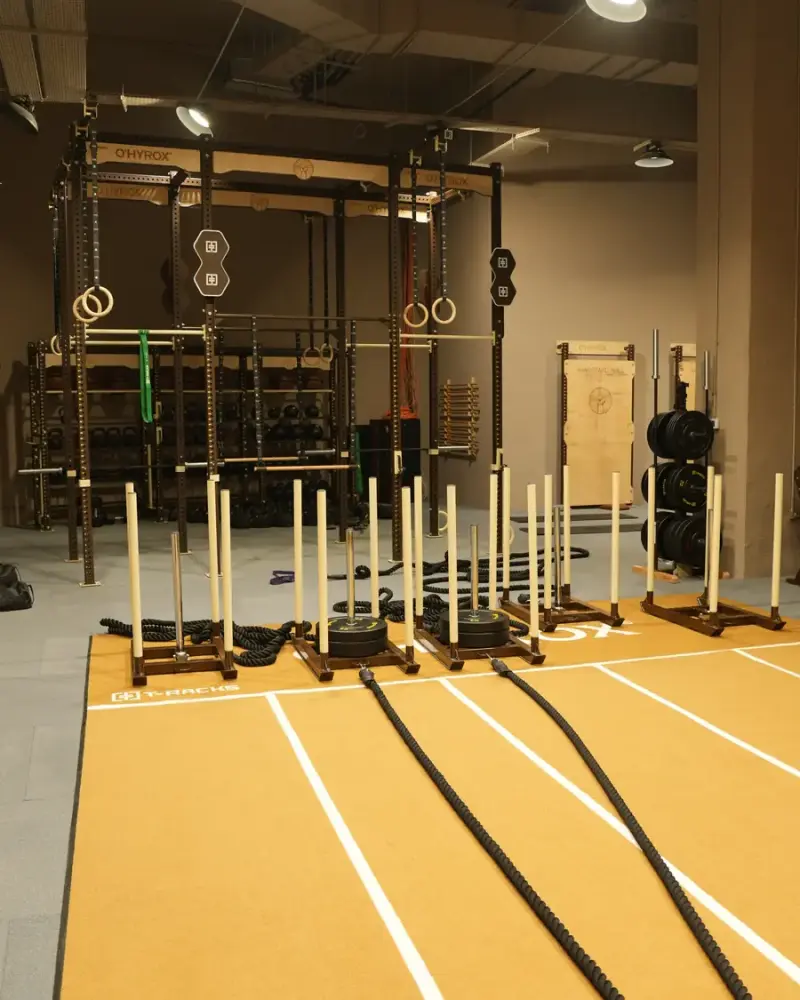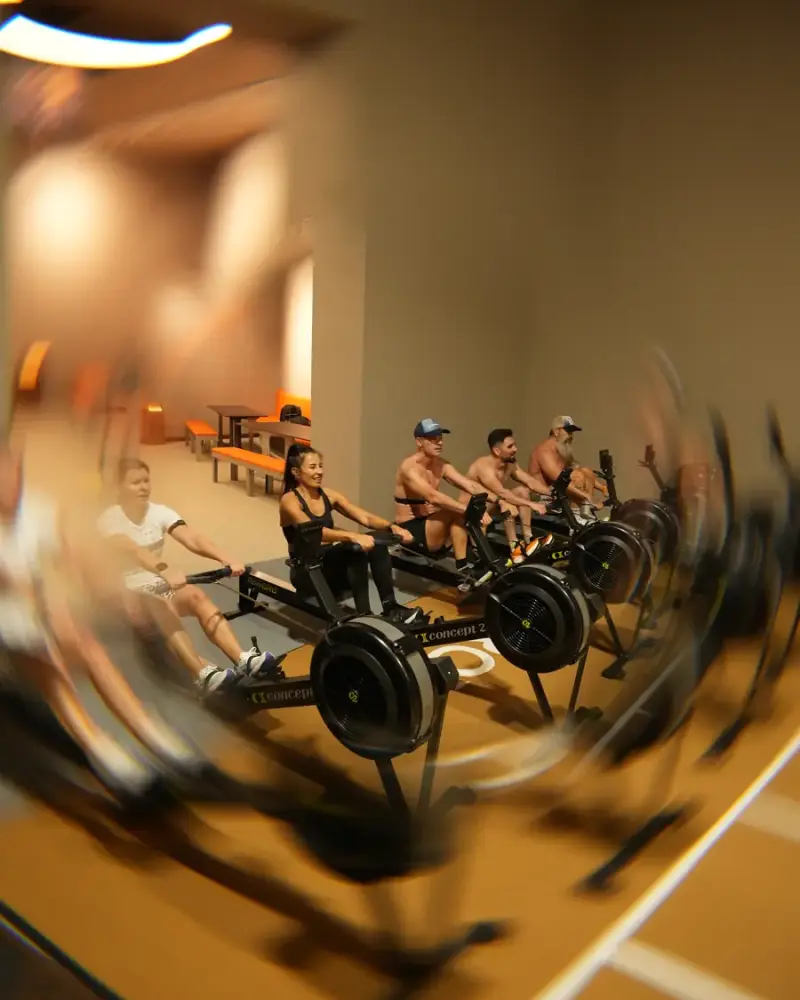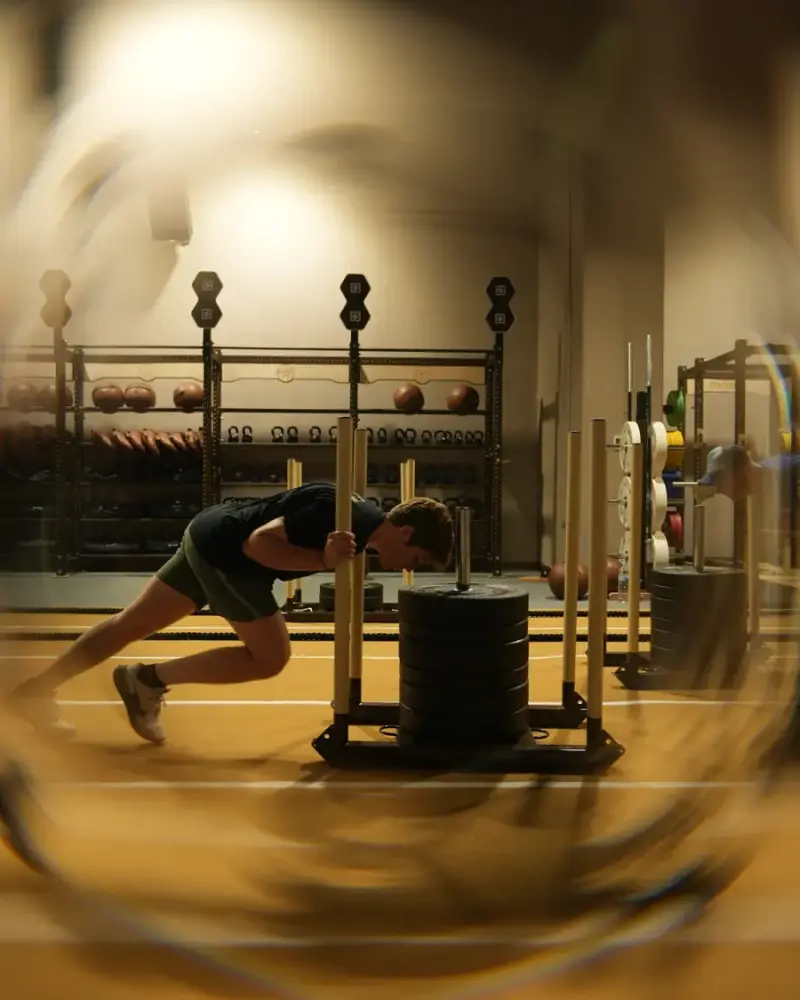
For most athletes, the journey from zero to a first HYROX goes through four phases over roughly 4-6 months: learning the movements, building a regular weekly rhythm, combining running and stations, and race-specific prep. In this article, we describe the process through a “typical journey” that doesn't belong to any real person; it's entirely fictional and drawn from many athletes' experiences. Let's call our character Deniz: in their 30s, works a desk job, hasn't trained regularly in years. What Deniz goes through isn't anyone's exact story; the goal is to show concretely which phases someone starting from zero goes through and what to watch for in each.
The starting point: “Can I really do this?”
Fictional Deniz's story starts with a question many people know. Seeing race photos shared by a friend, Deniz looks up what HYROX is and reads about the format: 8 × 1 km runs, each followed by a station. SkiErg, sled push, sled pull, burpee broad jump, rowing, farmers carry, sandbag lunges and 100 wall balls. The first reaction: “this is too much for me.”
This reaction is very common and comes largely from encountering the whole format for the first time. In reality, HYROX's Open category is open to anyone who trains regularly, and most racers aren't elite athletes but ordinary people preparing in time carved out from work and family. Deniz's first step is to honestly assess their own starting point. Our articles on how fit you need to be to do HYROX and can a gym beginner prepare for HYROX offer a realistic framework.
Having not trained for a long time, Deniz chooses to get a health check before starting regular training. This is a smart step for anyone, especially those who are older or have a known health issue.
Phase 1 (roughly weeks 1-4): Learning the movements
When Deniz arrives for the first session, it's far less tiring than expected, because the goal of early sessions isn't to wear you out but to learn the movements. Basic patterns like squatting, hip hinging, pushing, pulling and carrying are practiced with light loads under a coach's supervision. In the first weeks, what's hardest isn't the load but coordination: nailing the legs-body-arms sequence on the rower, and merging the squat and throw on wall balls into one movement.
The most important lesson of this phase is patience. The muscle soreness at the end of the first week reminds Deniz that the body is adapting to a new load. 2-3 sessions a week, walks in between and enough sleep are the basic structure of this period. For what to expect in your first session, see the coming to your first session article, and for the overall plan of the first month, see the first 4-week beginner plan article.
Common challenges in this phase
- Trying to keep up with the rest of the group and letting technique break down.
- Interpreting muscle soreness as “I did something wrong” and thinking about quitting.
- Neglecting the running; yet half the race is running.
Phase 2 (roughly weeks 5-10): Building a rhythm
In the second phase, the issue is no longer knowing the movements but keeping up the weekly routine. For fictional Deniz, the biggest challenge of this period isn't physical but logistical: work meetings run long, evening traffic jams up, a week of illness hits. We know many athletes starting from zero quit during this period, because the initial excitement has worn off but the results aren't yet obvious.
The strategy that works for Deniz in this period is to mark training times in the calendar as fixed appointments and to accept the week as it is rather than piling missed sessions onto the next day. Getting to know a few people who come to group classes at the same time also creates an extra reason to show up. We covered the community's role in this period in our Hybrid Sky community article. For practical ways to protect your training time in Istanbul, see our article on protecting your training time in Istanbul traffic.
By the end of this period, Deniz notices that the movements that were hard in the first weeks now come without thinking. The 1 km run time has dropped, and holding pace on the rower for longer is now possible. The change isn't dramatic, but it's measurable.
Phase 3 (roughly weeks 11-16): Combining running and stations
The most important feature that sets HYROX apart from other types of training is that running and stations come back to back. When you start running after the sled push, your legs feel heavy and you're short of breath. This is usually called “compromised running,” and it only improves with practice. In this period, run and station combinations are added to Deniz's program: for example, a 1 km run followed by a station, for several rounds.
In this phase, Deniz feels for the first time, “I'm really preparing for a race.” It's also the first time the weak station becomes clear: wall balls. Forget finishing 100 reps unbroken; after 20 reps, the shoulders start to burn. This finding sets the focus for the remaining weeks. For the logic of combination training, see the compromised running article, and for wall ball strategy, see wall balls: finishing 100 reps unbroken article.
| Stage | Focus | Weekly sessions (approx.) | Measure of success |
|---|---|---|---|
| 1. Learning the movements | Technique, basic patterns | 2-3 | Doing the movements correctly with coach approval |
| 2. Building a rhythm | Consistency, aerobic base | 3 | Sticking to the weekly plan without gaps |
| 3. Combining | Run + station combinations | 3-4 | Holding technique when tired |
| 4. Race-specific prep | Simulation, pacing, taper | 3-4 | Executing the plan in the race flow |
Phase 4 (final weeks): Race-specific prep
In the final phase, Deniz picks a race. To choose a date and city, Deniz checks the official HYROX calendar and registers in the Open category for a race that fits the prep time. Simulations are added to the program in this period: first a half, then a full simulation in the final weeks before the race. In-club simulationsare where Deniz experiences the race flow from start to finish for the first time.
In the first simulation, Deniz makes a classic mistake: running the first 1 km fast out of excitement and slowing down noticeably in the second half. This experience teaches the importance of pacing before race day. In the second simulation, Deniz starts calmer and the total time improves. On pacing, the HYROX pacing strategy article offers detailed guidance.
In the final week before the race, volume drops. During this period, Deniz feels oddly restless, thinking too little training is being done. This is a common side effect of the taper and it's normal. HYROX taper article helps you understand this period.
Nutrition and sleep: the invisible prep
In this final phase, Deniz realizes the hours outside training matter as much as the training itself. Session quality drops when sleep gets short during busy weeks, and on days without enough food before training, fatigue sets in early at the stations. So, approaching the race, Deniz regulates bedtime and ties pre- and post-training nutrition to a simple plan. None of it is complicated, but consistency makes a difference within a few weeks. On this topic, our sleep and performance and HYROX nutrition guide articles offer guidance.
Race day and after
Race day in our fictional story resembles many first-timers' experience. Deniz eats the race-morning breakfast as tested beforehand, arrives at the venue early and completes the warm-up. The first half of the race goes as planned. On the sandbag lunges the legs start to burn, and the wall balls get broken into more sets than planned; but having lived these moments in simulations, Deniz doesn't panic. Crossing the finish line, the time is a few minutes longer than targeted. It doesn't matter; the real goal, finishing, has been achieved.
The week after the race, Deniz trains lightly and reviews the race. Like nearly every first-timer, the question on Deniz's mind is: “How much better can I be next time?” We covered first-race mistakes in our first HYROX race mistakes article and prep for a second race in how to lower your time in your second HYROX.
The role of the coach and club in this journey
In our fictional story, the coaches and the club environment play a clear part in Deniz's progress. A structure that corrects technique in the first weeks, adapts the program during disrupted weeks in the second phase, identifies the weak station in the third and builds the pacing plan together in the final phase catches many mistakes early compared with preparing alone. That doesn't mean no one can prepare alone; but for someone starting from zero, getting feedback shortens the learning process considerably. For what coaching covers, see what does a HYROX coach do article.
6 lessons from this fictional journey
- Wherever you start, the first step is technique. Learning the movements correctly makes every later phase easier.
- The hardest period is usually the second phase. Once the initial excitement fades, calendar and community support are important for staying consistent.
- Don't neglect running. Half the race is running, and running after a station is a skill in itself.
- Identify your weak station early. A mid-prep assessment makes the final weeks productive.
- A simulation is a chance to make mistakes before the race. Pacing mistakes learned in a simulation aren't repeated in the race.
- In your first race, the goal is to finish. A time goal can wait for your second race.
Deniz's story is fictional, but what happens at each phase will be familiar to many athletes starting from zero. If you're thinking of starting a similar journey, the club's level test day is a good opportunity to establish your starting point. Hybrid is located in the O’Wellness Sky complex in Sarıyer; for information on the class schedule and beginner options, reach us via the contact page you can write to us.
Is the athlete in this article a real person?
No. Deniz is an entirely fictional character; the story is compiled to show the phases athletes starting from zero commonly go through.
How long does it take to prepare for a first HYROX from zero?
It varies from person to person; for someone who hasn't trained in a long time, a gradual process of several months is realistic. For those with a regular training background, 12 weeks is usually enough.
Which category should I choose for my first race?
For most new athletes, the Open category is the best start. If you're preparing with a partner, Doubles can also be a good option.
Where should I start if I've never trained before?
First get your health checked, then start with 2-3 sessions a week in beginner classes focused on learning technique.
A stronger version of you.
Just one step away.
24 hours from your first message to your first session. Let's build your program together — reach out on whichever channel suits you.
Weekdays 06:00 - 23:00