The most effective way to find a Doubles partner at Sky is to spend time in the same sessions as athletes who train regularly at the club and have a similar running pace, then test the match with a few joint workouts. Hybrid Sky has natural places to meet for this, such as group classes, in-club simulations and Doubles matchmaking day. Choosing a good partner isn't just about who's stronger; pace compatibility, communication and a shared goal matter far more. This article explains what to look for in a partner, how to test compatibility and how to go about it at the club.
Why does your partner matter so much in Doubles?
In HYROX Doubles, two athletes complete the 8 × 1 km runs together and can split the work at the stations however they like. So on the runs you both move at the same time, while at the stations one works as the other rests. This structure has two important consequences. First, the team's running pace is set by the slower partner. Second, if the work split at the stations is set up well, the team can work at a much higher intensity than in an individual race.
That's why partner choice is one of the most important variables in Doubles performance. For the format's rules in detail, see our HYROX Doubles rules article, and for work-split tactics, our Doubles strategy article.
Another feature of Doubles is its psychological side. In an individual race, you can drop your own pace when you're tired; in Doubles, you feel a sense of responsibility to your partner. With the right partner, this feeling is motivating; with the wrong one, it can turn into pressure. How your partner supports you in a tough moment is reflected directly in how much you enjoy the race as well as in your time. So when choosing, pay attention not only to test results but also to how you feel training together.
6 qualities to look for in a good partner
| Feature | Why does it matter? | How do you tell? |
|---|---|---|
| Similar running pace | You run 8 km together; a big gap slows the team down | Time difference in a 1 km test run |
| Complementary strengths | If one is strong on the sled and the other on the ergometers, splitting the work is easier | Station-by-station test results |
| Shared goal | If one races for fun and the other for a time, tension arises | Open communication |
| Compatible schedules | You need to be able to train together | Comparing weekly availability |
| Contact | In a race you need to communicate briefly and clearly | Observation in joint sessions |
| Reliability | Registration, travel and prep are done together | Showing up to training consistently |
“The strongest athlete” isn't on this list. That's because in Doubles, two very strong but incompatible athletes can get a worse result than two mid-level but compatible ones. For a more detailed compatibility assessment, you can read our article on choosing a training partner.
Where to find a partner at Sky
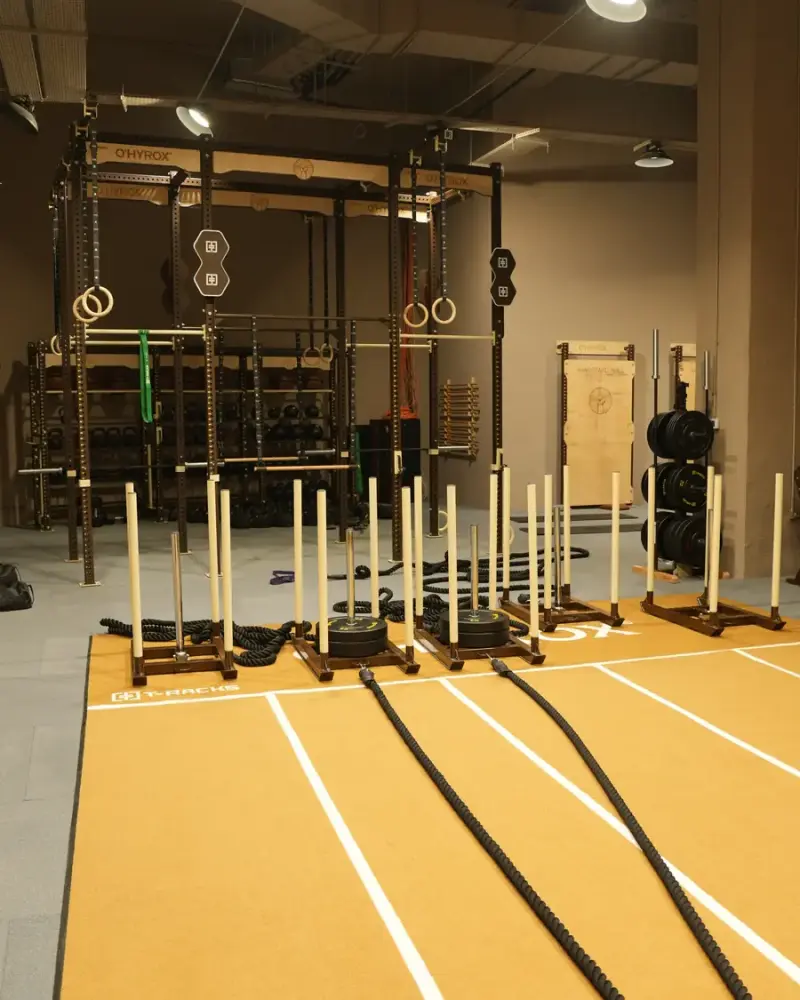
Hybrid Sky is a club dedicated to HYROX in the O’Wellness Sky complex in Sarıyer. This setup naturally makes finding a partner easier: everyone training at the club is preparing for the same race format. The most natural ways to find a partner are:
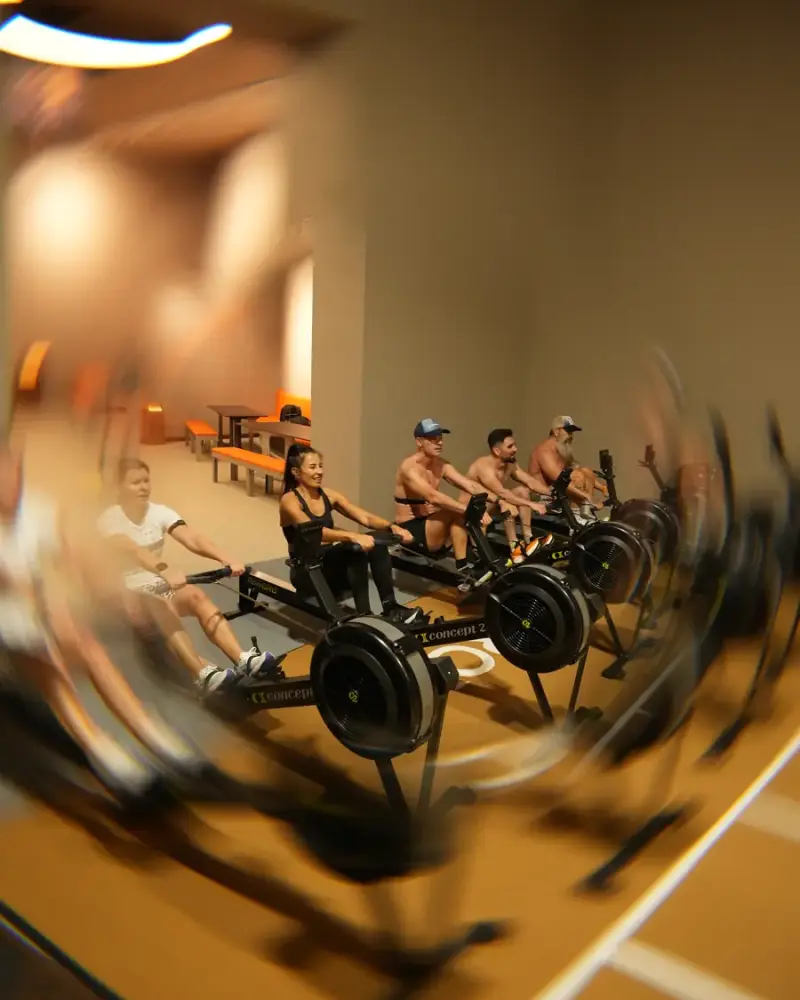
- Group classes: Over time, you get to know athletes who come regularly at the same time. You get the chance to observe their level and how they work. Hybrid conditioning and similar classes work on running and stations together, so pace compatibility is easy to see.
- Doubles and Relay class: Doubles & Relay classes focus directly on partner formats; while working on transitions and the work split, you get the chance to try out different partners.
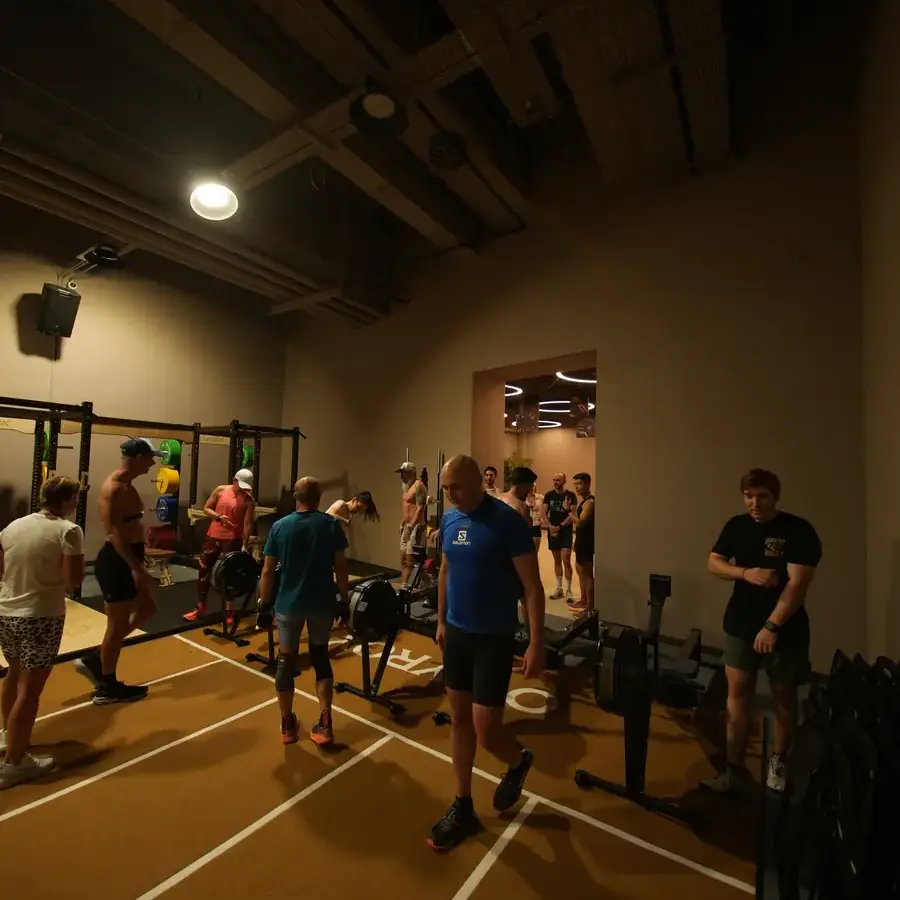
- Doubles matchmaking day: Doubles matchmaking day is an event designed to bring together athletes looking for a partner.
- In-club simulations: In in-club simulation races, you see athletes at race pace; this is the most realistic chance to observe them.
- Asking the coaches: Coaches know the level and goals of the club's athletes; they can introduce you to people with a similar profile.
Testing compatibility: 3 joint sessions
Once you've agreed with a partner, it's wise to test your compatibility before registering for a race. The three sessions below are a good start for seeing both physical and communication compatibility. Session loads should be set with your coach according to your level.
Session 1: Pace test
Each of you runs 1 km separately at a controlled hard pace, and you compare times. Then run 4 × 1 km together with short rests in between. While running together, watch whether the slower one is struggling and whether the faster one gets impatient. If the time gap is small and running together feels comfortable, that's a good sign.
Session 2: Splitting the station work
Work through a shortened version of each station in order and note who is stronger at which station. Try different schemes, for example splitting SkiErg and Row evenly, having the stronger partner do most of the Sled Push, and breaking Wall Balls into short sets. Find which scheme flows better for the two of you.
Session 3: Mini simulation
Complete half the race together, that is 4 runs and 4 stations, at close to race intensity. The main thing to watch in this session is communication: who goes in when at each switch, how does the tired partner say so, how is the pace adjusted on the run? Review it together after the mini simulation.
Splitting the work: common schemes
How you split the station work in Doubles depends on your partner's strengths. The table below offers sample schemes to start with; you'll only find the ideal scheme through joint training.
| Station | Even split | Stronger partner does more |
|---|---|---|
| SkiErg 1000 m | Alternating short blocks | The partner stronger on the ergometer does longer blocks |
| Sled Push / Pull | Half the distance each | The stronger partner does more distance |
| Burpee Broad Jump | Short alternating blocks | The lighter, more agile partner does more |
| Row 1000 m | Alternating blocks | The partner stronger on the ergometer does more |
| Wall Ball 100 | Alternate in short sets | The partner with more durable shoulders does longer sets |
For exact rules and switching procedures, always check the official HYROX rulebook and our HYROX rules article.
When setting your scheme, think especially about the second half of the race. An even split is easy at the start, but as fatigue builds, one partner may drop off noticeably. In that case, having a “plan B” agreed in advance means there's no need to argue mid-race. For example, you can set flexible rules like shortening the tired partner's set length on Wall Balls or switching more often on Sandbag Lunges.
5 things to discuss with your partner
Aligning expectations matters as much as physical compatibility. Discussing these topics openly before registering prevents tension down the line:
- Goal: Finishing, a specific time or an enjoyable experience?
- Training frequency: How many joint sessions a week are possible? If one trains in the morning and the other in the evening, how will you meet?
- Race choice: Which race, which date, is travel involved? Use the official HYROX calendar for dates and locations.
- Budget and logistics: How will registration and any travel costs be planned?
- In-race communication: Short, clear signals for fatigue, pace changes and switches.
A joint prep program with your partner
Once you've found a partner, the most effective approach is to keep your individual programs while adding at least one joint session a week. Individual sessions let each partner work on their own weak points; the joint session locks in pace, work split and communication. As the race approaches, the share of joint sessions can increase.
For example, in a 12-week prep, joint sessions in the first weeks can focus on communication and pace compatibility, in the middle weeks on trying out the station work split, and in the final weeks on full or half simulations. For the general principles of programming, see 12-week HYROX program article.
Measuring progress together
Repeating the same test every few weeks during your joint prep lets you see your progress concretely. For example, you can repeat a mini simulation of 4 runs and 4 stations every 4-5 weeks and note the total time and number of switches. Keeping a shared training log shows who is improving at which station and how the work split should be updated.
What if you can't find a partner?
A suitable partner isn't always available right away. In that case, you have a few options. First, race in the individual Open category to get to know the format and meet more athletes at the club over time. Second, join a four-person Relay team; since Relay is a more flexible format, athletes of different levels can race together. For this, see the how Team Relay works article. Third, tell the coaches your goal and availability; a good match may turn up among new athletes.
It's also important not to turn your partner search into a rushed decision. Rather than agreeing with someone you don't know under registration pressure, deciding after a few weeks of joint training once you've seen your compatibility protects both your race experience and your relationship at the club. If you realize you're not compatible, talking about it early and openly is the healthiest path for both of you.
To meet athletes looking for a partner at the club and get current information on the class schedule or matchmaking events, reach us via the contact page message us. For the club's overall setup and the HYROX scene in Istanbul, the HYROX Istanbul guide is a good starting point.
Do I have to be at the same level as my Doubles partner?
You don't have to be, but a similar running pace is important because you run 8 km together. Differences at the stations can be balanced with the work split.
Which event should I attend to find a partner at Sky?
Doubles matchmaking day is designed for this purpose. Doubles & Relay classes and in-club simulations are also good opportunities to get to know athletes.
How many joint workouts a week should we do with a partner?
At least one joint session a week while keeping your individual programs is a good start. This number can increase as the race approaches.
What can I do if I can't find a partner?
You can race in the individual Open category or join a four-person Relay team. Telling the coaches your goal also improves your chances of a match.
A stronger version of you.
Just one step away.
24 hours from your first message to your first session. Let's build your program together — reach out on whichever channel suits you.
Weekdays 06:00 - 23:00