For a HYROX athlete living on the European side, transport is part of the training program: the most sustainable setup is to schedule weekday sessions at a facility no more than 25-30 minutes away one way, and long and simulation sessions at a fully equipped facility. The reason isn't motivation but arithmetic; a 45-minute one-way commute for four sessions a week adds up to about twelve hours a month, equivalent to three weeks of training volume. Below we cover the time, route and program decisions specific to the European side.
Why is travel time a training variable?
When writing a program, people talk about volume, intensity and recovery; transport rarely comes up. Yet over the long term the most common reason programs fall apart isn't injury or loss of motivation, but sessions failing to stick in the calendar. A session's “doability” depends on three things: a fixed time, a predictable commute and a backup plan ready in case of cancellation.
In İstanbul, the most fragile of the three is the commute. The same route can take 20 minutes at 5:30 p.m. and 50 minutes at 6:30 p.m. That uncertainty creates a fear of being late to the session; the fear leads to a rushed warm-up and a lower-quality main set. So planning your commute is really planning your warm-up and your session quality. We explained why the warm-up should never be cut short in the warm-up protocol article .
A quick calculation helps: add up your total weekly travel time and see how many sessions it equals. If travel time exceeds fifty percent of your weekly training time, it's time to rethink your facility or your session time. The technical criteria for choosing a gym in this article .
Decision table by time slot
| Session time | Advantage | Risk | Best suited for |
|---|---|---|---|
| 06.30-08.00 | Short commute, empty facility, low cancellation risk | Sleep schedule must shift earlier, warm-up gets longer | People with fixed working hours |
| 12.00-14.00 | Moderate traffic and crowding, the day gets split | If the lunch break is short, the session gets squeezed | People who live close to work |
| 17.00-18.30 | Body temperature and performance are high | Peak traffic, waiting for equipment at the facility | People with flexible finishing times |
| 19.30-21.00 | Traffic eases, the space starts to empty | Sleep quality may be affected | Evening chronotypes |
In the table, the most popular but riskiest slot is 17.00-18.30; it's the busiest time both on the road and at the facility. Waiting five minutes for an ergometer or sled breaks the structure of a planned interval session. We weighed the performance difference between morning and evening sessions in the timing article .
Public transport or car?
On the European side, rail transit is more predictable than driving on most routes during evening rush hour. Predictability is worth more than speed, because it makes it possible to fix your session time. On the other hand, making two transfers on a route rail doesn't cover can make the total time longer than by car.
On the car side, what matters isn't arrival but parking. If the facility has no parking, the extra 10-15 minutes you need to add eats into the session. That's why, when deciding, you need to measure total door-to-door time, not the driving time your navigation app shows.
A third option is to place the session on your route between work and home. Going home and heading back out is the scenario with the highest cancellation rate in İstanbul, because once you're home, the odds of going out again drop sharply. Sample weekly setups for office workers in this article is laid out there.
Short on weekdays, long on weekends: the two-facility model
The most practical transport solution is often not insisting on a single facility. The model works like this: two or three short weekday sessions are done somewhere close to home or work; on the weekend you go to the fully equipped facility and do the long run, station work or simulation there. That way you pay the commute only once or twice a week.
- Weekday session 1 (nearby facility): strength — squat or deadlift as the main lift, accessory pulling, a short core block.
- Weekday session 2 (nearby facility or outdoors): threshold work — 5 × 800 meters or 4 × 6 minutes.
- Weekday session 3 (optional): 30-40 minutes of easy aerobic work, rowing or SkiErg.
- Weekend session 4 (HYROX-equipped facility): station-based hybrid session or a half simulation.
- Weekend session 5: long easy run, 50-75 minutes.
The weak point of this model is that station contact drops to once a week. Sled and wall balls are skill-based; once a week is enough to maintain, but borderline for progress. If your race is less than eight weeks away, you need to increase station sessions to twice a week. We explained simulation planning in the full and half rehearsal article, the weak-link analysis in the station analysis in more detail.
Running outdoors: practical options on the European side
Half of HYROX is running, and most running volume is accumulated outside the facility. On the European side, the places where you can run flat and uninterrupted are the shoreline, large parks and campus-like closed-loop areas. Three criteria help when choosing: surface continuity, the number of traffic lights and night lighting.
The number of traffic lights is especially decisive for threshold sessions; an 800-meter repeat broken up by a 40-second wait at a light doesn't deliver the intended stimulus. That's why for interval sessions you need to find an uninterrupted 400-600 meter stretch wherever possible. The differences between the treadmill and outdoors in this article .
In winter some of these options drop out. The framework for moving running work indoors on rainy, icy and polluted days in the winter preparation article, the details of running in cold weather in this article too.
Ways to turn travel time into training
Time spent commuting doesn't have to be a total loss. There are three practical uses. First, use time on public transport to mentally build that day's session plan; on simulation days in particular, this rehearsal makes a measurable difference. Second, deliberately increase the distance you walk: getting off one stop early and walking quietly raises your weekly volume of low-intensity movement.
Third, use the commute as a recovery window. Finishing your post-session fluids and protein on the way home lowers the chance of skipping a meal once you arrive. Mental rehearsal techniques in the visualization article, post-session nutrition in this article too.
The simple rule to use when deciding
First decide how many sessions a week you can do, then choose the facility where you can hit that number. A facility with perfect equipment that you can't get to more than twice a week gives worse results than one with average equipment that you can get to four days a week. We calculated the relationship between number of days and progress in the days-per-week article .
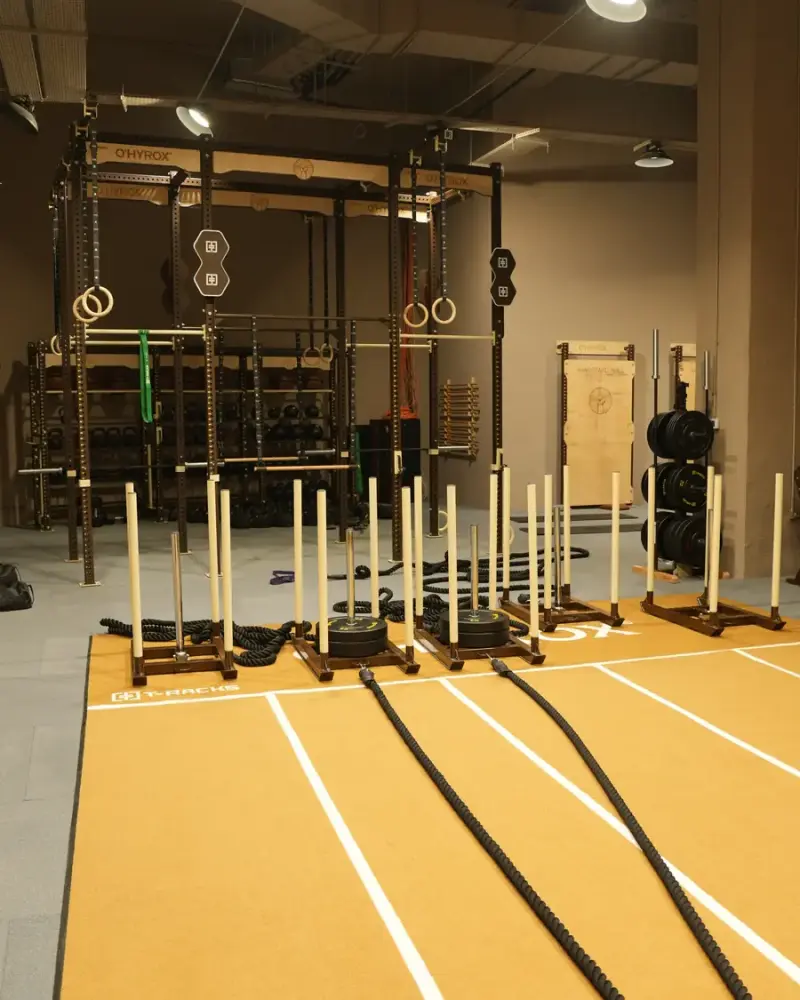
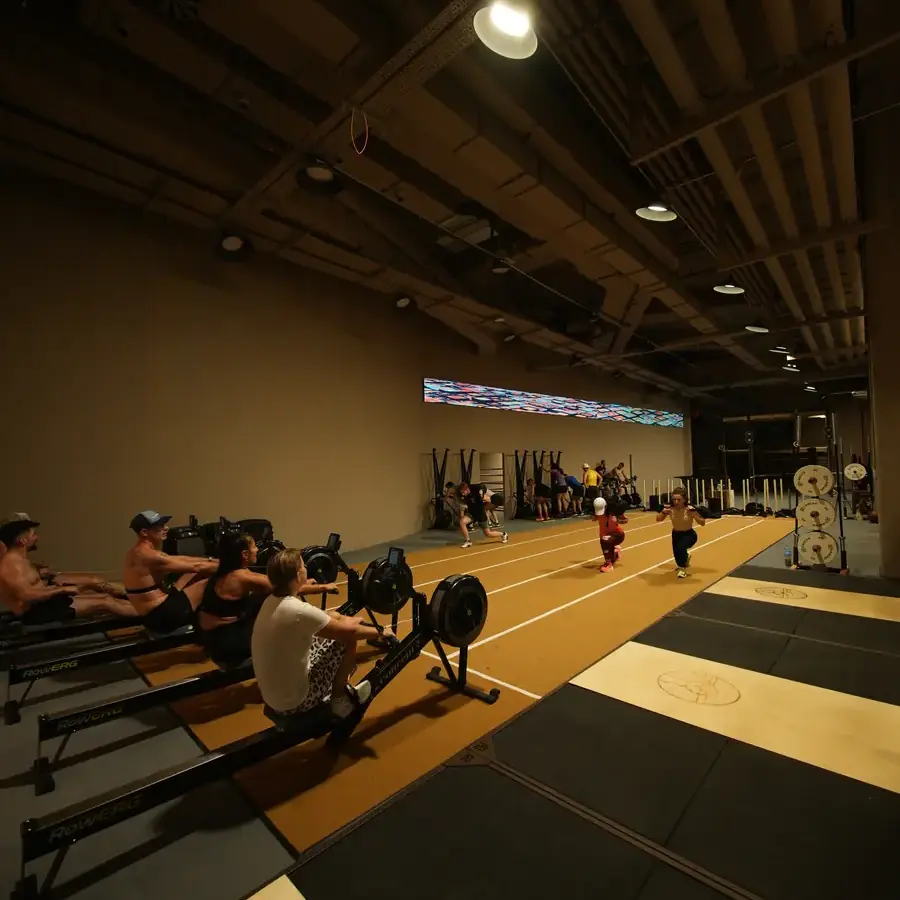
Hybrid is the HYROX club inside the O’Wellness Sky complex; since the complex also offers fitness and pilates, spa and padel, station work, general strength and recovery can be done in a single trip. This is a concrete advantage that lowers commuting costs in multi-session weeks. You can see the session types on the classes page, the weekly flow in the class schedule ; questions about transport, times and capacity reach us via the contact page can be sent our way.
Example: writing travel time into your weekly plan
The fastest way to turn an abstract discussion into something concrete is to add travel time as a line in your plan. When you write down the total time from leaving your door to getting back, it becomes obvious which session is truly sustainable.
| Day | Session | At the gym | Commuting | Total |
|---|---|---|---|---|
| Monday | Strength | 70 min | 60 min | 130 min |
| Tuesday | Zone 2 run (from home) | 50 min | 0 | 50 min |
| Thursday | Station + interval | 70 min | 60 min | 130 min |
| Saturday | Simulation | 100 min | 45 min | 145 min |
In this table the weekly total is about seven and a half hours, of which two hours forty-five minutes is commuting. The key point: the only session with no commute is the Zone 2 run straight from home, which makes it the most reliable link of the week. In busy periods the first session to get cancelled is usually the one with the longest commute; building your plan around that determines how many sessions you actually do over three months.
When deciding how many days you can manage per week, the weekly frequency article offers a framework that also accounts for travel time.
How much travel time is acceptable for training?
On weekdays, 25-30 minutes one way is the practical upper limit. Commutes longer than that noticeably increase the session skip rate within four to six weeks.
Does public transport or driving make more sense?
During evening rush hour, rail transit is more predictable on most routes. A car is an advantage on days when you carry equipment or your session is late.
Does moving sessions to the morning solve the commute problem?
Largely, yes. Early in the morning travel time is shorter and the cancellation risk is lower; in return, you need to shift your sleep schedule earlier.
Does it make sense to use a distant facility on weekends?
Yes. Doing short weekday sessions somewhere nearby and long and simulation sessions at a fully equipped facility is a model that works well.
A stronger version of you.
Just one step away.
24 hours from your first message to your first session. Let's build your program together — reach out on whichever channel suits you.
Weekdays 06:00 - 23:00