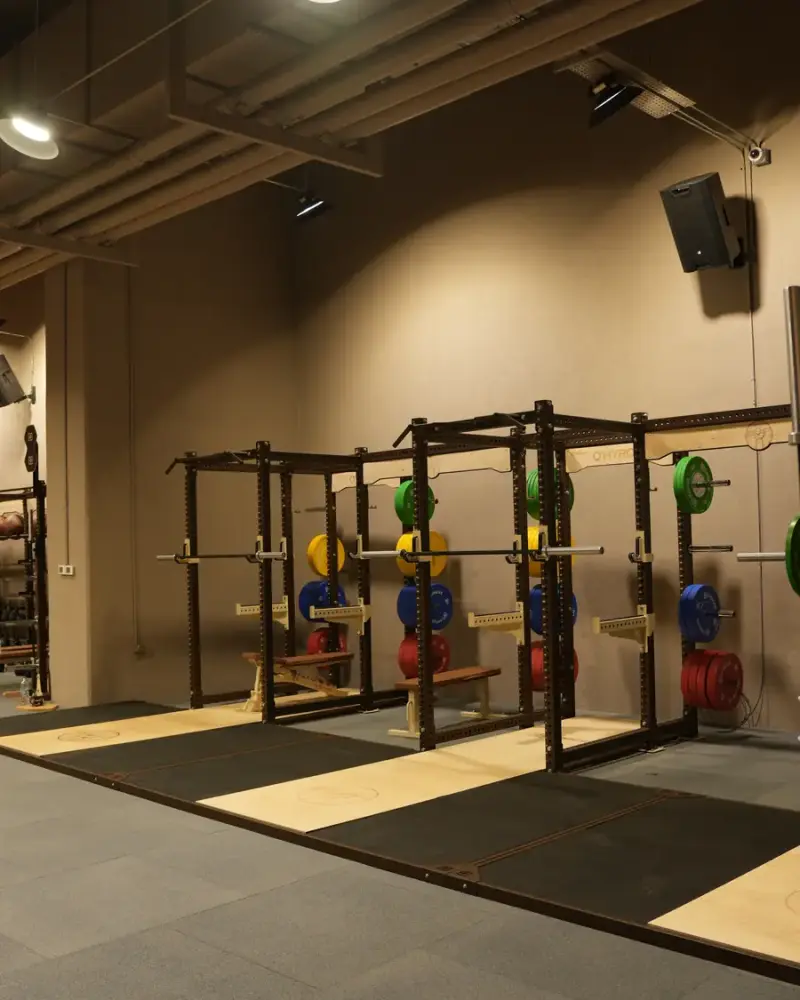
A strength base for HYROX building one is the step most athletes put off the longest in their preparation, yet it’s the most decisive. Without squat and deadlift targets, the sled push, farmers carry, and sandbag lunge stations turn not into a strength test but into a fight for survival. At least five of the race’s eight stations rely directly on lower-body and posterior chain strength.
At O’Hybrid Sky, we often notice this in our prep programs at Skyland İstanbul: athletes with good aerobic capacity are comfortable on the runs but lose minutes at the sled station. In this article, we cover realistic strength targets for HYROX, how to reach them, and how to balance strength work with endurance.
Why the Strength Base Comes First
Strength is the foundation of endurance. When your max squat strength goes up, the force you use during the sled push becomes a smaller percentage of your max. The same absolute work becomes relatively easier. In HYROX, this directly affects how quickly you recover when leaving a station and heading into the run.
The reverse is also true: an athlete with a weak strength base pushes the sled at near-maximal effort every meter. Heart rate spikes, lactate builds up, and the next run collapses. 40 seconds lost at the station turns into a minute lost on the next kilometer.
Absolute Strength vs. Relative Strength
In HYROX, station weights are fixed; they aren’t adjusted to your body weight. So the weight on the sled is the same whether you weigh 70 kg or 95 kg. That means absolute strength is critical for lighter athletes. On the other hand, since you have to carry your body weight on the runs and in the burpee broad jumps, relative strength matters too. Finding the balance point is the art of preparation.
Squat Targets
The squat is the most transferable foundational movement for the sled push and sled pull. It develops knee and hip extension together and challenges core stabilization. In a HYROX context, realistic target ranges can be thought of like this:
- Beginner level: A clean back squat rep with a load equal to your body weight. This is the minimum for working through the stations without technical collapse.
- Intermediate: About 1.3-1.5 times body weight. In this range, the sled push gets noticeably easier.
- Advanced: 1.7 times body weight and above. The zone targeted by athletes racing in competitive divisions.
These numbers aren’t absolute rules; they’re guiding references. Training history, age, body type, and injury history change the targets. What matters is making measurable progress from your own starting point.
Which Squat Variation?
The back squat is the most efficient tool for absolute strength. The front squat transfers better to wall balls and sandbag lunges because it develops an upright torso and upper back strength. The split squat and Bulgarian split squat are indispensable for single-leg strength and hip stability; the lunge station tests exactly that. The ideal program rotates these three across different blocks.
Deadlift Targets
The deadlift is the most powerful tool for loading the posterior chain, meaning the hamstrings, glutes, and back muscles, all together. The sled pull, sandbag carry, farmers carry, and rowing stations all depend on the posterior chain. The deadlift itself isn’t a HYROX station, but its effect spreads everywhere.
- Beginner level: 1.2-1.3 times body weight, without technique breaking down.
- Intermediate: 1.7-2 times body weight.
- Advanced: 2.2 times body weight and above.
Rushing to reach a target deadlift weight is one of the costliest mistakes for hybrid athletes. Endurance training already creates a serious fatigue load; adding aggressive max attempts on top of that drains your recovery budget. Technical consistency should always come before weight.
The Role of the Romanian Deadlift
The conventional deadlift is trained for max strength, while the Romanian deadlift is trained for hamstring length and controlled eccentric strength. In HYROX, the quality of the hip hinge determines performance, especially on the sled pull. Keeping both in your weekly program, one heavy and the other in a moderate rep range, works well.
Fitting It into Your Weekly Program
A hybrid athlete’s biggest constraints are time and recovery. There are practical rules for fitting strength work into the same week as endurance:
- Two heavy lower-body sessions a week are enough; a third is too much for most athletes.
- Separate a heavy strength session from an intense running session by at least one day.
- If you have to do them on the same day, put strength first and running second.
- Focus on intensity rather than volume: 3-5 sets in the 3-6 rep range are efficient for strength gains and have a low recovery cost.
- Aim to leave 1-2 reps in reserve on every set rather than going to failure on the last rep.
In O’Hybrid Sky sessions at Skyland İstanbul, strength blocks are usually placed early in the week, while the weekend is reserved for race simulation and long runs. In practice, this layout is the most sustainable arrangement for athletes living in Sarıyer with busy work schedules.
Progression Method
Strength gains aren’t linear. Fast gains in the first months followed by a slowdown are normal. The best approach for hybrid athletes is gradual load increases in 4-6-week blocks followed by a light week. Dropping the weights by 20-30 percent in the light week lets the gains settle in.
Don’t measure progress by weight alone. Better technique, a faster drive, and shorter recovery at the same weight are all signs of progress. Especially as the race approaches, you need to drop max weight goals and shift to strength endurance.
Moving into Race Season
6-8 weeks before the race, the character of strength work changes. The goal of increasing max strength gives way to maintaining existing strength and applying it under fatigue. The number of sets drops, and the movements become more like the race stations. Specific sled push and wall ball work takes priority.
If this transition isn’t made, an interesting thing happens on race day: the athlete is strong but tired and can’t use their strength. Conversely, if the transition happens too early, the strength base won’t be developed enough. Timing is the most critical planning decision in preparation.
Safety and Technique
Heavy squats and deadlifts are safe movements when done correctly; done incorrectly, they carry unnecessary risk. Before adding load, lock in your range of motion and your breathing and bracing technique. If you have ongoing pain in your lower back, knees, or hips, consult a health professional before adding load.
Spending the first weeks under an experienced eye is worth far more than the time it will save you in the months that follow. That’s the biggest benefit of group sessions: technical feedback comes on the spot.
Wrapping Up
HYROX looks like an endurance race, but without a strength base it’s impossible to get through the stations. The squat and deadlift are the two most efficient tools for building that base. Set realistic targets, track your progress, and take recovery seriously.
Athletes training at O’Hybrid Sky’s facility in Sarıyer, Istanbul with an approach that combines strength and endurance in a single plan quickly see that the real source of the seconds lost at the stations is a strength gap. Build the base, and the rest is built on top of it.